Design principles:
- Not a new encoding, only linearize MusicXML (with minimal changes).
- e.g. token order is determined by MusicXML element order
- e.g. token names are determined by MusicXML element names and values
- Focus on the visual part of MusicXML, not the audio part. Try to encode graphemes, not semantics (while still sticking to MusicXML)
- e.g. use
<type>instead of<duration> - e.g. ignore
<alter>pitch element
- e.g. use
- Ignore precise typesetting information, focus on the musical content.
- e.g. notehead positions, measure widths, system breaks, page breaks
- Remove excessive verbosity to make the linearization feasible for ML models.
- e.g. represent stem/beam/staff/voice changes, not its value for each note
Additional decisions:
- Based on W3C MusicXML v4.0: https://www.w3.org/2021/06/musicxml40/
- Works with
score-partwisedocuments, see this page for more info. - Ignores all the metadata (
<part-list>,<identification>), linearizes only the<part>element contents (measures with music). - Linearizes measures "in-parallel", no measure-to-measure dependencies (keeps minimal state information - no assumed key signature or time signature).
Some symbols are omitted from the encoding: - e.g. dynamic markings, hairpins, pedal signs, glisando
In this documentation, MusicXML elements are represented by angle brackets (e.g. <note>, <chord>) and linearized MusicXML token types are represented by square brackets (e.g. [pitch], [type]).
At the end of this document, there is a grammar pseudocode that specifies what tokens can be combined in what order.
While MusicXML may allow more freedom in how music is represented (say, voices, backup/forward, staves), we based our decisions based on the data taken from the OpenScore Lieder corpus, when exported to MusicXML through MuseScore 3.6.2. This provides us with additional structure (such as voice order), which is not important in our case, but you should take into consideration if using other sources of MusicXML.
This is important, as there are multiple way how to encode the same music (multiple MusicXML documents that render to the same printed score). The variability is in:
- ordering of chord notes
- ordering of voices
- usage of
<forward>elements vs. invisible rests - naming of voices (for example, MuseScore names second-staff voices 5-8, instead of 1-4)
- naming of other values, where MusicXML lets you input
string, without further specification
It is not obvious, how to choose the canonical representation among all possible representations of the same music piece. Therefore we decided to use MuseScore 3.6.2 as the source of canonical MusicXML for this project. If you ever need to harmonize MusicXML from multiple sources, consider these variations.
Here, each section documents a specific part of the encoding.
A note is the fundamental building block of music and it consist of three properties: pitch, onset, duration. The onset is encoded implicitly in the linear ordering of notes and their durations. Therefore we only need to encode the pitch and the duration.
The core token that identifies a note is the pitch token. No other musical symbol contains pitch in MusicXML, you can see that <pitch> element can only be a child of the <note> element.
In MusicXML, pitch is by <octave>, <step>, and <alter>. We join the first two values to build the pitch token:
C4 E4 G4 F5 ...
This is the scientific pitch notation.
In MusicXML the octave ranges from 0 to 9 and steps are A, B, C, D, E, F, G.
In the OpenScore Lieder train dataset we encountered these pitches:
__ __ __ __ __ __ __
__ __ __ __ __ __ __
C7 D7 E7 F7 G7 A7 B7
C6 D6 E6 F6 G6 A6 B6
C5 D5 E5 F5 G5 A5 B5
C4 D4 E4 F4 G4 A4 B4
C3 D3 E3 F3 G3 A3 B3
C2 D2 E2 F2 G2 A2 B2
C1 D1 E1 F1 G1 A1 B1
__ __ __ F0 G0 A0 B0
Since this covers almost the entire range, it makes sense to take all combinations of 0-9 and A-G as the note pitch tokens, which gives us 70 distinct tokens.
The <alter> value is ignored during linearization, because:
- It can be reconstructed from the key signature and preceeding accidentals.
- Is not in any way explicitly visually present in the music score.
- If added would introduce a stateful dependency across measures (from the key signature), which would break the encoding's measure-independence feature.
Duration of a note in the linearized MusicXML is represented by the <type> element (note type, e.g. half, quarter, half). The <duration> element is designed for processing by audio replay software, and can be calculated back from the <type> is the given context (time signature, tuplets) is present, so we consciously ignore it.
We only make sure the
<duration>value is what we expect, given the musical context.
The reason is that <type> is graphically, explicitly represented in the score, whereas <duration> is represented implicitly.
These are the <type> values allowed by MusicXML:
1024th 512th 256th 128th 64th
32nd 16th eighth quarter half whole
breve long maxima
These are the values present in OpenScore Lieder train set:
__ __ __ 128th 64th
32nd 16th eighth quarter half whole
breve __ __
Therefore we recommend using all the 14 values specified by MusicXML. This gives us 14 type (duration) tokens.
The conversion between <type> and <duration> is controlled by the divisions element, stated (usually) at the beginning of a part in <attributes>. The <divisions> dictates, how many time units does a single quarter note take up. This is a quarter note, regardless of the time signature. In a 3/2 time signature one measure takes up 3 half notes, so six quarter notes. So six-times the <divisions> value is the duration of a single measure. But one quarter note still takes up one <divisions> worth of time.
What DOES affect <duration> is tuplets via the <time-modification> element. If a note is an eighth note and should take 36 time units, if it's in a 3in2 tuplet, it takes up only 24 time units (while still being an eighth note). See this MusicXML example.
With nested tuplets, this is a mess, but the <time-modification> is relative to the top-most-level, i.e. it can be used directly to compute the proper <duration> just from knowing the <type> without parsing the complex tuplet nesting. See this MusicXML example.
Rest is a kind of notation that behaves like a note without pitch. A note that is not played. Therefore we represent rests like notes, where the pitch token has been replaced by the rest token. The rest token is immediately followed by the type (duration) token.
Vertical rest position is not encoded (used in polyphony).
If a rest is alone in a measure, it is considered to be a measure rest and it always looks like a whole rest, even if the measure contains only three quarter notes at maximum. Because of this, measure rests are encoded in MusicXML with a measure="yes" attribute. This rest lacks the <type> element (since its meaning is kind of dissolved because of the duration-exception).
For this reason measure rests cannot use the [type] token and a new token rest:measure is introduced in its place to serve as the new syntactic root of the [note] token sequence.
Note that sometimes the measure rest may not even be displayed, because there are multiple staves and this rests applies only to one of the staves. See measure 40 here.
Linearized MusicXML encodes stem orientation, because MusicXML encodes it via the <stem> element.
MusicXML allows four values:
down up double none
In practise, notes without any stem lack the <stem> element completely. Similarly, notes with two stems are represented as two separate <note> elements in two different voices, each having its own stem. This means that in the OpenScore Lieder corpus, when exported by MuseScore, only down and up and missing <stem> element are possible values.
But there are cases, where slurs from multiple voices converge on a chord. Since slurs cannot cross voices, the solution is to have two chords, one for each voice, placed on top of each other, and one of the voices is missing its stems. This is where the none value is used. You can see in the picture, the last eighth note chord has green stem and flag, which means the second voice is normal. But the blue voice (first voice) only has the two noteheads, but no stem:

Note: sample taken from here, measures 8-9: https://musescore.com/user/27638568/scores/6211549
The none staff is also used for overlapping voices, such as here:

Therefore we define three new tokens:
stem:up stem:down stem:none
To cut sequence length, we track stem orientation implicitly in this fashion:
- When we start encoding a measure, we don't have a stem orientation specified and we remember that the stem orientation is
NULL - Notes without any stems do not contain any stem tokens.
- The first note that contains a stem, gets the appropriate stem token (always, since we start by tracking
NULL), and we start tracking that stem orientation as our new "implicit" stem orientation. - Whenever we hit a note (with a stem) with a different stem orientation than currently tracked, we output the appropriate stem orientation token and start tracking the new orientation.
- The tracked stem orientation is reset to
NULLwhenever:- New measure is entered
- New voice is entered (see the
<backup>element)
In MusicXML, chord is not an explicit object, but something that emerges from the relationship of multiple notes. If we have a chord with three notes, these three notes are represented almost like individual notes, but the last two notes contain the <chord> element. This element indicates, that these notes are additional noteheads for a singular chord.
For noteheads (notes) of a chord, some features are shared, and some are distinct:
pitch- each note has its own pitchtype- all notes typically have the same type, but MusicXML does allow for the variability of type within a chord, so our linearized MusicXML also does. This means that we repeat the[type]token for each note even when it's almost always the same.accidental- each note has its own accidentals, complete independencestem- stem orientation is tracked as if the notes were independent (so only the first one may have the stem orientation token)beam- beaming information is always present on the first note, never on a note that contains the<chord>element.grace- grace notes can be chords, then all the grace notes have the<grace>element, and chord notation works just like for non-grace notes (grace notes are just notes that have no duration)rest- rests cannot participate in chordstie- each note has its own tie notation (chord notes can have ties), usually all have the samedot- each note has its own dot notation (chord notes can have ties), usually all have the same
Notes within a chord are ordered by MuseScore from the lowest-pitch to the highest. MusicXML does not enforce any order, but we use this order so that the representation is not ambiguous and can be used to train ML models.
Beams in MusicXML are represented by the <beam> element on a note, stating whether a beam starts, continues, or ends at that note. It also tracks multiple beams separately, giving them numbers.
We linearize this by converting the start and end (and hooks) to tokens. We ignore the continue elements to reduce sequence length and make the encoding stateful in a similar way to how stem orientation is represented.
Also, we ignore the beam numbering, since in most music, the beams are nested (they never cross).
This introduces 4 new tokens (see the MusicXML spec):
beam:begin beam:end beam:forward-hook beam:backward-hook
The token is doubled (tripled, ...) if there are two or more beams running through a note (just like MusicXML has multiple <beam> elements).
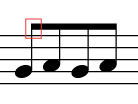
So a beamed group of 4 eighth C4 notes are represented like this:
G4 eighth beam:begin
A4 eighth
G4 eighth
A4 eighth beam:end
And if the first two a sixteenth notes and the last two are eighth notes:
C4 16th beam:begin beam:begin
C4 16th beam:end
C4 eighth
C4 eighth beam:end
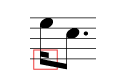
There may also be a sixteenth hook, like this:
E5 16th beam:begin beam:forward-hook
C5 eighth dot beam:end
The <accidental> element in MusicXML is present, when there's a graphical accidental visible in the score next to the note. This is the way our linearized MusicXML encodes semitones, not the <alter> pitch element, that is ignored.
The OpenScore Lieder corpus uses these accidentals:
sharp flat natural
double-sharp flat-flat natural-sharp natural-flat
There are additional values possible, but we don't focus on microtonal music, so we choose to ignore them.
This introduces 7 tokens to the linearized MusicXML vocabulary.
The graphical representation of a tie is in MusicXML represented within the <notations> element by the presence of a <tied> element. There also exists a <tie> element, but that has audio meaning, not notation meaning so we ignore it.
The element has one attribute type with values start and stop. We convert this to two tokens that we attach to a note:
tied:start tied:stop
If a note is both an end and a start of a tie, it contains both of these tokens in this order (the same order is used in MusicXML).
Each note can contain zero or many duration dots. Each one of those dots is in MusicXML represented by a <dot> element. Each one of these element occurences gets translated to a dot token in the linearized MusicXML representation.
Grace notes are regular notes, that (are smaller) and don't have duration. Other than that, they behave like any other notes from the perspective of MusicXML.
In MusicXML these are represented by an element <grace>, that behave similarly to the <chord> element. Therefore in the linearized representation, grace notes are represented by a grace token.
Grace notes can be slashed, which in MusicXML is represented by an attribute slash="yes". If that attribute is present, then the "grace" token is followed by a "grace:slash" token.
In MusicXML a clef is represented within the <attributes> element in between notes. It has three important values:
<sign>- what type of clef is this (G, C, F)<line>- what staffline it sits on (1, 2, 3, 4, 5 - numbered from the bottom line up)number- attribute containing the staff number (1 or 2 or missing)
This is the distribution of clefs in the OpenScore Lieder corpus:
Counter({'G2': 4018, 'F4': 2825, 'G1': 4, 'C1': 2, 'F3': 1})Clefs often change at the beginning of a measure. The first measure defines both clefs in one <attributes> element (staff 1 first, then staff 2). If the part is not a piano grandstaff, the staff number is omitted.
If a clef changes in the middle of a measure, it is annotated in the first voice of a staff. So second staff clef change is annotated in the sequence of notes of the first voice of the second staff. This is very likely defined by MuseScore, since MusicXML just states that the modification happens score-wise, not MusicXML note-order-wise. If at the beginning of a measure only one clef changes, only that one clef is notated. The other one is not - it is kept implicit from the previous measures. The specific placement of clefs in the note stream for these experiments is driven by the output ordering and formatting of MuseScore.
Sometimes a clef is notated at the end of a system, because it changes at the beginning of the next system. This is only typesetting feature and is not encoded in MusicXML nor its linearization (but the clef change on the next system is of course encoded).
In MusicXML, clefs at the beginning of systems are NOT explicitly encoded. However we train an end-to-end model that only gets systems, without the information of preceeding notation. So to correctly decode a system, we add explicit repetition of clefs at the beginning of each system measure (just like what is done in the actual printed score). (note that this does not apply for time signatures, only clefs and key signatures)
Key signature is represented in MusicXML by the <key> element inside of the <attributes> element. It can contain:
<fifths>- encodes the number of sharps or flats<cancel>- explicit cancelling of the previous key signature, since not used in OpenScore Lieder corpus, we ignore this element<mode>- specifies the mode of the key (major, minor, dorian, ... unusual ones), here only "major", "minor", and "none" are used in the corpus; but this element is ignored because it encodes a semantic "meaning" or "understanding" of the key with respect to the song - it has no effect on the number, or positioning of the key signature accidentals
The <fifths> element value is a number - the number of flats/sharps, in range:
-7 -6 -5 ... -2 -1 0 1 2 ... 5 6 7
Negative values are flats, zero is no signature, positive are sharps (the number of them). This is the distribution of signatures in the corpus:
Counter({'0': 228, '1': 226, '-1': 212, '-3': 194, '2': 173, '4': 167,
    '-2': 160, '-4': 152, '3': 130, '5': 78, '-5': 77, '-6': 30, '6': 17,
    '7': 4, '-7': 3})
Key signature is in MusicXML explicitly notated at the begining of a part even if it's 0. (maybe because MuseScore does that, not that MusicXML requires it). Then it's notated at the beginning of a measure whenever the signature changes.
Key changes mid-measure are not allowed in MuseScore (see this thread) and so they will not appear in our data.
Sometimes a key change is notated at the end of a system, because it changes at the beginning of the next system. This is only typesetting feature and is not encoded in MusicXML nor its linearization (but the key change on the next system is of course encoded).
In MusicXML, key signatures at the beginning of systems are NOT explicitly encoded. However we train an end-to-end model that only gets systems, without the information of preceeding notation. So to correctly decode a system, we add explicit repetition of key signatures at the beginning of each system measure (just like what is done in the actual printed score). (note that this does not apply for time signatures, only clefs and key signatures)
On reading time in music:
Time signature consist of two numbers on top of each other (Cmeans4/4andcrossed Cmeans2/2). The top number states the number beats per mesure, the bottom one states the type of the beat./2means one beat is one half note,/4means one beat is one quarter note. The tempo (e.g.tempo: 140) means the number of beats per minute. The<divisions>MusicXML states the number of time units per quarter note (not the beat!) - a quarter note may be half a beat in a2/2meter. Because of this, whole notes do not fit into less-than whole measures (e.g.3/4is filled by a dotted half note, or three quarter notes). Measure rests are an exception! They look like whole restst, but if they are alone in the measure, they are used even if the measure is less-than-whole. This is the only exception and MusicXML encodes them with a special attribute.
When analyzing the OpenScore Lieder corpus, we find these time signatures being used:
     1/4
2/2  2/4  2/8
3/2  3/4  3/8
4/2  4/4  4/8  4/16
     5/4  5/8
     6/4  6/8  6/16
     7/4  7/8
          8/8
     9/4  9/8  9/16


          12/8


          15/8
Although the frequency is biased towards a few, the distribution is still quite broad:
Counter({'4/4': 705, '3/4': 546, '2/4': 538, '6/8': 326, '3/8': 149,
    '9/8': 114, '2/2': 83, '12/8': 50, '3/2': 48, '6/4': 40, '4/8': 16,
    '9/4': 10, '5/4': 10, '7/8': 10, '4/2': 7, '2/8': 5, '1/4': 3, '8/8': 3,
    '6/16': 2, '9/16': 2, '15/8': 2, '5/8': 1, '7/4': 1, '4/16': 1})
So for this reason and for maximum similarity to MusicXML we decided to code both numbers as separate tokens. This adds these 20 tokens to our vocabulary:
beats:1 beats:2 beats:3 ... beats:16
beat-type:2 beat-type:4 beat-type:8 beat-type:16
We also add the token time that represents the <time> XML element, so that it's easier to decode malformed sequences (we can ignore all beat and beat-type tokens that do not follow a time token directly).
So an example 3/4 time signature would be encoded as these three tokens:
time beats:3 beat-type:4
Which neatly mirrors the XML:
<time>
    <beats>3</beats>
    <beat-type>4</beat-type>
</time>
Time signature in MusicXML is stated at the first measure and then during changes. In notation, the same behaviour occus (another words, time signature is NOT re-stated at the begining of each system). We DO NOT re-state the time signature at the beginning of each system even though we train an end-to-end model on individual systems. We don't do this because the printed notation does not do that AND the model does not need it, because the encoding does not enforce measure durations explicitly and note durations are encoded visually via the note type.
Sometimes the notation setting software places time signature at the end of a line, when the measure on the next line has a different time signature. This cautionary time signature is not encoded, only the next measure's time signature will be encoded.
Here are some interesting scores, time signature-wise, for testing:
- https://musescore.com/score/6196804 (12/8, 6/8, 9/8)
- https://musescore.com/score/6447372 (7/8, 5/8, 3/8)
- https://musescore.com/score/6166579 (4/4, 3/8, 6/8)
- https://musescore.com/score/6156388 (9/16, 3/8, 9/16)
- https://musescore.com/score/5861338 (4/4, 3/2, 2/2, 4/4)
Tuplets and tremolos are the notation elements, that utilize MusicXML's <time-modification> element. This element lets us define notes, that are non-2 division of time.
Normally, we have quarter notes and eighth notes. A quarter note triplet has duration in between - it takes 2/3 of a quarter note in duration. Similarly we can define fifths, sevenths, etc. A standalone tuplet note is identified by its type and the time-shrinking ratio from <time-modification>. For reason we decided to extend the note [type] with a [time-modification] token, which is computed directly from the <time-modification> MusicXML element.
So a quarter note triplet would be encoded like this:
C4 quarter 3in2
There are two regular quarters in two quarters (in a half note), so a regular quarter note is 2in2, or rather 1in1 so the time modification is omitted. But there are three triplet quarter notes in two regular quarter notes, so 3in2.
Sometimes, triplets are actually written in groups of 6, which makes them sixtuplets (with the same duration). In such a case, their time modification is 6in4 (which is technically identical to 3in2, but semantically not).
Apart from the duration information, tuplets are usually grouped by brackets or beams to form tuplet groups, so that they are easier to read. This information in MusicXML is stored in <notations>/<tuplet> element. We encode this information separately in two tokens:
tuplet:start tuplet:stop
There are no nested tuplets in the corpus, so we ignore these.
Double-note tremolos come with <time-modification> as well, because these are two notes, that together have the duration of one of only one of these notes. (e.g. two tremolo-beamed half notes in the duration of a single half note). For this reason, MusicXML adds a 2in1 time modification to these double tremolos. LMX keeps this information as well.
Tremolos are marked like other ornaments with tokens:
tremolo:single
tremolo:start
tremolo:stop
tremolo:unmeasured

tremolo:1
tremolo:2
tremolo:3
tremolo:4
Tremolo element statisticis in OSLiC:
<tremolo type="start">3</tremolo>  1104
<tremolo type="stop">3</tremolo>   1104
<tremolo type="start">2</tremolo>  893
<tremolo type="stop">2</tremolo>   893
<tremolo type="single">1</tremolo> 444
<tremolo type="single">3</tremolo> 105
<tremolo type="start">1</tremolo>  50
<tremolo type="stop">1</tremolo>   50
<tremolo type="single">2</tremolo> 20
<tremolo type="start">4</tremolo>  2
<tremolo type="stop">4</tremolo>   2
Note that there are no tremolo:unmeasured tremolos in the corpus.
Interesting scores to test on:
- https://musescore.com/user/27638568/scores/5974308 (sixteenth triplets)
- https://musescore.com/user/27638568/scores/6581327 (tremolos)
- https://musescore.com/user/27638568/scores/5015573 (triplets with invisible numbers - rule of continuation)
- https://musescore.com/user/27638568/scores/4985999 (triplets with invisible numbers - rule of continuation)
- https://musescore.com/openscore-lieder-corpus/scores/5052823 (more tremolos)
Time modification statistics:
Counter({'3in2': 100988, '6in4': 13514, '2in1': 4935, '2in3': 1133,
    '5in4': 718, '7in8': 203, '7in6': 196, '9in8': 174, '4in3': 96,
    '7in4': 70, '4in6': 61, '13in8': 52, '22in16': 42, '10in4': 40,
    '12in8': 24, '9in4': 19, '10in8': 19, '18in4': 18, '16in8': 16,
    '15in8': 15, '5in3': 14, '11in8': 11, '11in12': 11, '5in2': 10,
    '8in2': 9, '4in2': 8, '7in1': 7, '35in16': 5})
We encode all the time modification tokens that appear in the corpus.
Measures begin with a measure token, and then a sequence of inner elements continues. So the measure token can be used as the measure separator and all information about the measure after the measure token and before the next measure token.
Monophonic music is typically written on only one-staff systems, whereas piano music is written onto two-staff systems. The piano two-staff system is sometimes called a grandstaff.
There may be even three-staff systems and there is one example in the corpus! But these cases are rare and will ignore them.
For single-staff music, there is no need to annotate which staff a given note belongs to. So none of the mentioned tokens are used in such a case. NOT EVEN EXPLICIT staff:1 TOKENS! (because MusicXML does not include the <staff> elements in such a case either)
For grandstaff music, a voice may transition from one staff to the other, so we need explicit notation. A multi-staff part begins its first <measure> with a <staves> element inside the <attributes> element, which contains 2 - the number of staves that will be used. Since stave count changes mid-part are rare, we chose to ignore this element during linearization.
The staff number is tracked in the same way to the stem orientation with tokens staff:1 and staff:2 (1 = upper, 2 = lower). The tracking is reset with measure start and voice change (<backup>), so the first notes of each voice always include the staff information and then notes that first switch to another staff include staff information.
During decoding, a measure can be checked to see if it contains these tokens and that can be used to disambiguate monophonic music from pianoforms.
We encode the voice in the same way we encode the <staff>. MuseScore defines 8 voices, 4 for each staff, so we decided to define 8 voice tokens:
voice:1 voice:2 voice:3 voice:4
voice:5 voice:6 voice:7 voice:8
This separation is a feature of MuseScore and other places don't use it. For example the MusicXML specification in their piano examples notate each staff voices from 1, never from 5.
Just remember that in order to combine MusicXML from multiple sources, you may need to rename voices so that they follow the same naming convention.
Forward element is used in secondary voices to skip to a future time position. It acts as an invisible rest, letting you start or end the second voice mid-measure.
In the linearized output sequence it behaves very much like the rest token, beacuse it's followed by the note type, specifying the duration:
forward quarter
If the MusicXML forward duration is not an exact value of a note type, we output multiple forward tokens with progressively smaller durations, until we define the duration precisely:
forward half forward quarter forward eighth C4 eighth
We considered the alignment of these time steps with the measure grid (stepping first up, to the whole quarter, whole half, etc.. and then down to hit the precise position), but we realized it's an unnecessary complication. Regular notes (and even rests) can be unaligned with the grid (say quarter note, half note, quarter note), so any ML model needs to handle these situations as well. So we chose to make the conversion simpler, and just go from the largest steps to the smallest until we hit the right duration.
NOTE: The following section describes, how tuplets could be added to forward/backup, but in the end it was so rare that we decided not to implement them. Take this as a guide, should it be added.
Also note, there are tuplet forwards required, for example here:

The time signature is 3/2 and three half notes are sliced up into three quarter-note triplets. The brackets are no longer displayed because of the rule of continuation. So each quarter note here is actually a quarter note triplet. So instead of quarter token, it should be a quarter 3in2 token pair.
In the top piano staff, the first stem-up quarter note triplet is in a separate voice and it requires the following forward to reach it from the start of the measure:
forward half forward half 3in2
The example is taken from: https://musescore.com/user/27638568/scores/5846184
For this reason, we allow the [type] token in forwards and backups to have the tuplet time modifiers found in regular tuplets:
3in2 5in4 6in4 7in8
Backup works just like <forward>, just that we move backwards in time.
Since a backup element is used whenever we define polyphony, it's an event that also resets the tracked voice number, staff number and stem orientation.
Note: Representing everything as something note-like with a duration, only going forward or backward in the music notation reminds me of two-way automata, interesting.
Sometimes, the input MusicXML contains invisible notes. Usually, these occur in ceratin hacks, where there was not a straightforward way how to encode a given piece of music. While it might seem unintuitive, we do encode this information in our linearized MusicXML sequence, because an ML model reading the notation has actually a way, how to figure out the presence of invisible symbols.
Here are a few examples:
- Tie or slur between voices - one of the terminal noteheads have to be doubled, so that the slur is actually only in a single voice, and one of the doubled noteheads becomes invisible. While complex, this process is deterministically done by MuseScore, so there should be a way for the ML model to learn it.
forward-like skips in the first voice are not possible. In MuseScore, you cannot delete first-voice rests. The only workaround is to make the rest invisible. Therefore, if there's aforward-like skip in the first voice, instead of producing aforwardtoken, you produce an invisible rest. This is fully deterministic.
Invisible notes/rests are encoded by a print-object:no token, which is placed as a note prefix, similar to chord or grace.
First, some statistics to get a sense:
# <notations>
Counter({'slur': 145962, 'tied': 71064, 'articulations': 56520,
'tuplet': 50560, 'arpeggiate': 23582, 'ornaments': 5069, 'fermata': 3691,
'technical': 320, 'non-arpeggiate': 177, 'slide': 12})

# <notations>/<articulations>
Counter({'staccato': 48882, 'accent': 14571, 'strong-accent': 4648,
'tenuto': 4613, 'staccatissimo': 1288, 'detached-legato': 1167,
'breath-mark': 198, 'soft-accent': 32, 'caesura': 12, 'doit': 1, 'scoop': 1})

# <notations>/<ornaments>
Counter({'tremolo': 5652, 'trill-mark': 437, 'wavy-line': 393,
'turn': 80, 'inverted-mordent': 77, 'accidental-mark': 26,
'inverted-turn': 19})

# <notations>/<technical>
Counter({'fingering': 511})

# grace notes (not <notations>, but very similar)
Counter({'grace': 7067})There are places where the MusicXML output from MuseScore is just strange, non-representative of the appearance of the score. This usually happens when the music notation breaks some assumptions about what music is (usually regarding multiple voices).
We decided to keep these hacks in, because they cannot in many cases be corrected (the MusicXML standard does not have the measures, or MuseScore does not use them) and they are fully deterministic. So despite being weird, they are actually learnable by an ML model and once produced by an ML model, MuseScore would actually understand them. So we declare them features of the notation and stick with them.
Here are the examples we found:
- Read the section about stems, how when you have two slurs from different voices converging on one chord, the chord must be made up of two voices (because slurs cannot cross voices), and therefore one part of the chord is a normal chord, and the other part is a stem-less chord for the other voice.
- When a tie crosses between voices, the starting note is re-entered again in the other voice with
print-object="no"attribute, so that the tie appears ok. - Rests can be deleted in secondary voices in MuseScore, which creates
<forward>elements, but not in the primary voice. There you have to create an invisible (print-object="no") rest instead.
This is an attempt at modelling the linearized MusicXML by a simple grammar:
Explainer:
- whitespace is concatenation
- parenthesis work as usual
?means optional (zero or one time)+is one or more times*is zero or more times|is alternation (one or the other)"asd"is a terminal[asd]is a non-terminal#is a line comment
# the whole linearized MusicXML sequecne is a [part] non-terminal
# and it is just a list of measures
[part] = [measure]+

# [measure] starts with the "measure" terminal and then contains notes
# and other notation primitives (noted as measure-item)
[measure] = "measure" [measure-element]*

# an element inside a measure
[measure-element] =
    | [note]
    | [key]
    | [time]
    | [clef]
    | [backup]
    | [forward]

[key] =
    | "key:fifths:-7"
    | "key:fifths:-6"
    | "key:fifths:-5"
    | "key:fifths:-4"
    | "key:fifths:-3"
    | "key:fifths:-2"
    | "key:fifths:-1"
    | "key:fifths:0"
    | "key:fifths:1"
    | "key:fifths:2"
    | "key:fifths:3"
    | "key:fifths:4"
    | "key:fifths:5"
    | "key:fifths:6"
    | "key:fifths:7"

[time] = "time" [beats] [beat-type]

[beats] =
    | "beats:1"
    | "beats:2"
    | "beats:3"
    | "beats:4"
    | "beats:5"
    | "beats:6"
    | "beats:7"
    | "beats:8"
    | "beats:9"
    | "beats:10"
    | "beats:11"
    | "beats:12"
    | "beats:13"
    | "beats:14"
    | "beats:15"
    | "beats:16"

[beat-type] =
    | "beat-type:2"
    | "beat-type:4"
    | "beat-type:8"
    | "beat-type:16"

# clef is the clef type token, combined with the staff number for grandstaves
[clef] = [clef-type] [staff]?

[clef-type] =
    | "clef:G1" | "clef:G2" | "clef:G3" | "clef:G4" | "clef:G5"
    | "clef:C1" | "clef:C2" | "clef:C3" | "clef:C4" | "clef:C5"
    | "clef:F1" | "clef:F2" | "clef:F3" | "clef:F4" | "clef:F5"

[note] = (
    [print]?
    [grace]?
    [chord]?
    ([rest] | [pitch] | [forward] | [backup])
    [voice],
    ([type] | "rest:measure")  # this is the ROOT of a [note], must be present, is used for parsing
    [dot]*
    [accidental]?
    [stem]?
    [staff]?
    [beam]*
    [tied]?
    [tuplet]*

    # ornaments
    [slur]*
    [fermata]?
    [arpeggiate]?
    [staccato]?
    [accent]?
    [strong-accent]?
    [tenuto]?
    [tremolo]?
    [trill-mark]?
)

# some objects are not printed
# (invisible cross-voice slur noteheads)
# (invisible rests in the first voice)
[print] = "print-object:no"

# [grace] indicates that the note is a grace note, can be slashed
[grace] = "grace" "grace:slash"?

# [chord] indicates that the note is a chord extension from the previous note
[chord] = "chord"

# [rest] indicates that the note is in fact a rest
[rest] = "rest"

# [forward] is like a rest, but not visible
# (used in secondary vocies to skip regions of notation)
# (note: muse score does not allow you to delete first voice resets,
# so there invisible rests are used insted)
[forward] = "forward"

# [backup] is like [forward], but the step is taken backwards
# it's like a note that has negative time duration
# (note: this reminds me of two-way automata)
[backup] = "backup"

# pitch in the scientific pitch notation
[pitch] =
    | "C0" | "D0" | "E0" | "F0" | "G0" | "A0" | "B0"
    | "C1" | "D1" | "E1" | "F1" | "G1" | "A1" | "B1"
    | "C2" | "D2" | "E2" | "F2" | "G2" | "A2" | "B2"
    | "C3" | "D3" | "E3" | "F3" | "G3" | "A3" | "B3"
    | "C4" | "D4" | "E4" | "F4" | "G4" | "A4" | "B4"
    | "C5" | "D5" | "E5" | "F5" | "G5" | "A5" | "B5"
    | "C6" | "D6" | "E6" | "F6" | "G6" | "A6" | "B6"
    | "C7" | "D7" | "E7" | "F7" | "G7" | "A7" | "B7"
    | "C8" | "D8" | "E8" | "F8" | "G8" | "A8" | "B8"
    | "C9" | "D9" | "E9" | "F9" | "G9" | "A9" | "B9"

# voice number that this note belongs to
[voice] =
    | "voice:1" | "voice:2" | "voice:3" | "voice:4"
    | "voice:5" | "voice:6" | "voice:7" | "voice:8"

# represents the duration of a note or rest
[type] = [type-normal] [time-modification]?

# normal note types (without any time modifications)
[type-normal] =
    | "1024th" | "512th" | "256th" | "128th" | "64th"
    | "32nd" | "16th" | "eighth" | "quarter" | "half" | "whole"
    | "breve" | "long" | "maxima"

# tuplets have this time modification right after the type name
[time-modification] =
    | '3in2' | '6in4' | '2in1' | '2in3' | '5in4' | '7in8' | '7in6'
    | '9in8' | '4in3' | '7in4' | '4in6' | '13in8' | '22in16' | '10in4'
    | '12in8' | '9in4' | '10in8' | '18in4' | '16in8' | '15in8' | '5in3'
    | '11in8' | '11in12' | '5in2' | '8in2' | '4in2' | '7in1' | '35in16'
    | '9in2'

# [dot] is a duration dot, one occurence for each notated dot
[dot] = "dot"

# possible accidentals
[accidental] =
    # the ususal ones
    | "sharp"
    | "flat"
    | "natural"
    # the weird ones from accidental overriding
    | "double-sharp"
    | "flat-flat"
    | "natural-sharp"
    | "natural-flat"
    # no microtonal music, this is enough
    # https://www.w3.org/2021/06/musicxml40/musicxml-reference/data-types/accidental-value/

# a change in orientation of stems
[stem] =
    | "stem:up"
    | "stem:down"

# a change in current staff
[staff] =
    | "staff:1"
    | "staff:2"
    | "staff:3"

# beam start or end or a hook
[beam] =
    | "beam:begin"
    | "beam:end"
    | "beam:forward-hook"
    | "beam:backward-hook"

[tied] =
    | "tied:start"
    | "tied:stop"

[tuplet] =
    | "tuplet:start"
    | "tuplet:stop"

[slur] =
    | "slur:start"
    | "slur:stop"

[fermata] = "fermata"
[arpeggiate] = "arpeggiate"
[staccato] = "staccato"
[accent] = "accent"
[strong-accent] = "strong-accent"
[tenuto] = "tenuto"
[trill-mark] = "trill-mark"

[tremolo] = [tremolo-type] [tremolo-marks]

[tremolo-type] =
    | "tremolo:single"
    | "tremolo:start"
    | "tremolo:stop"
    | "tremolo:unmeasured"

[termolo-marks] =
    | "tremolo:1"
    | "tremolo:2"
    | "tremolo:3"
| "tremolo:4"At this page you can see the list of all MusicXML elements in a tree-structure. Here we list these elements (or element groups) and state, whether they belong to the encoding, or are ignored for some reason:
Root of the MusicXML document
<score-partwise>
Root of the actual musical content
= The thing that we convert back and forth
<part>Used elements:
<measure> converted to [measure]
<attributes> not explicitly linearized, only its contents
<clef><line><sign> converted to [clef]
<divisions> used but not explicitly linearized
<key><fifths> converted to [key]
<staves> used but not explicitly linearized
<time><beat-type><beats> converted to [time]
<backup> used for voice changes
<duration> used in backup/forward, implicitly used in notes and rests
<forward> used for invisible restst within voices
<note> converted to [note]
<accidental> converted to [accidental]
<beam> converted to [beam]
<chord> converted to [chord]
<dot> converted to [dot]
<grace> converted to [grace]
<pitch><octave><step> converted to [pitch]
<rest> converted to [rest]
<staff> converted to [staff]
<stem> converted to [stem]
<time-modification> used for tuplets, converted to [time-modification]
<type> converted to [type], encodes duration
<voice> used but not explicitly linearized
<notations> not explicitly linearized, only its contents
<articulations> not explicitly linearized, only its contents
<ornaments> not explicitly linearized, only its contents
<technical> not explicitly linearized, only its contents
<tied> converted to [tied]
<tuplet> converted to [tuplet]
<slur>
<fermata>
<arpeggiate>
<staccato>
<accent>
<strong-accent>
<tenuto>
<tremolo>
<trill-mark>Ignored, because they are metadata that do not affect the music itself:
<score-partwise>
<credit>
<defaults>
<identification>
<movement-number>
<movement-title>
<part-list>
<work>Ignored knowingly - it should never be added for some reason
<directive> deprecated since MXL 2.0
<print> contains layout information only, we DO use it for system slicing, but not for linearization
<sound> contains non-visual data
<alter> pitch alter is linearized implicitly by key signature and accidentals
<play><ipa><mute><other-play><semi-pitched> sound data? (i guess)
<tie> indicates sound, tied indicates notationIgnored by omission - it is rare, strange, obscure, but may be added in theory
<clef-octave-change> rare
<footnote> contains free text
<for-part>
<instruments>
{key}<cancel><key-accidental><key-alter><key-octave><key-step><mode> key signature features
<level> contains free text
<part-symbol>
<staff-details>
{time}<interchangeable><time-relation><senza-misura> time signature features
<transpose><chromatic><diatonic><double><octave-change>
<bookmark>
<direction> dynamic, hairpins, piano pedals - ignored because it's non essential to notes themselves
<figured-bass>
<grouping><feature>
<harmony>
<link>
<listening><offset><other-listening><sync>
<cue> cue notes
<instrument>
<listen><assess><other-listen><wait>
<lyric> contains free text
<notehead>
<notehead-text><accidental-text><display-text>
{rest}<display-octave><display-step> positional information for rests is not important for reading, only printing
<unpitched><display-octave><display-step> we are not currently interested in drums
{note}<dynamics> MuseScore attaches dynamics to direction, not to notes, so there are none of these elements
<measure-style> not present in the corpus, was not needed, should be handled if encountered
<barline> not essential to notes themselvesIgnored notations - exist, but are too infrequent, pain to implement:
<non-arpeggiate>
<glissando>
<slide>
<fingering>
<staccatissimo>
<detached-legato>
<breath-mark>
<soft-accent>
<caesura>
<wavy-line>
<turn>
<inverted-mordent>
<inverted-turn>
<accidental-mark>Ignored notations - rare:
<doit>
<scoop>
<falloff>
<other-articulation>
<plop>
<spiccato>
<stress>
<unstress>
<other-notation>
<delayed-inverted-turn>
<delayed-turn>
<haydn>
<inverted-vertical-turn>
<mordent>
<other-ornament>
<schleifer>
<shake>
<vertical-turn>
<technical> all except for fingering, that does occur a bit