Course: Jetson ESP-Hosted Host Code guide · Phase 2 — Embedded Linux
Previous: Lecture 01 · Next: Lecture 03 — SPI transport and IRQs
Read:
esp_hosted_ng/host/jetson_orin_nano_init.sh
This file tells you the validated board assumptions:
RESETPIN=-1HANDSHAKEPIN=471DATAREADYPIN=433SPI_BUS_NUM=0SPI_CHIP_SELECT=0SPI_MODE=2CLOCKSPEED=10
This is not random configuration. It is the board policy layer for the Jetson dev kit.
Embedded Linux takeaway:
- upstream code often assumes one board
- production bring-up usually needs a board-specific wrapper or policy layer
This lecture lines up best with:
- OS Lecture 5 — Kernel Modules, Boot Process & Device Tree
- OS Lecture 17 — Linux Device Driver Model & Device Tree
Lecture 5 explains why loadable modules and board description are separate concerns: the board says what hardware exists, and the module provides behavior for it. That separation is exactly why jetson_orin_nano_init.sh can focus on Jetson policy while esp32_spi.ko focuses on transport and subsystem integration.
Lecture 17 explains driver binding and the Linux device model, which is the right mental model for the spidev unbind step. The script is not “doing something hacky”; it is clearing a generic driver off a real SPI device so the intended driver can bind to the same kernel object.
The important Embedded Linux idea here is that “loading a module” is not the same as “hardware is now usable.” A module can load successfully and still fail to bind the right device, fail to claim the right GPIOs, or fail later when it tries to register itself with Wi‑Fi or Bluetooth subsystems.
That is also why this lecture spends so much time on shell script policy. In real systems, a small wrapper script often carries the board truth: which bus is real, which GPIO numbering scheme the kernel expects, whether reset is safe to drive, and whether a generic placeholder driver like spidev must be removed first.
The kernel interfaces and concepts to watch here are:
- out-of-tree kernel modules
insmodandmodule_param(...)- device ownership and driver binding
- device tree exposing a bus before the real driver claims it
The defaults are stated directly in the helper:
IF_TYPE="spi"
MODULE_NAME="esp32_spi.ko"
RESETPIN=-1
HANDSHAKEPIN=471
DATAREADYPIN=433
SPI_BUS_NUM=0
SPI_CHIP_SELECT=0
SPI_MODE=2
CLOCKSPEED=10
That small block captures most of the Jetson-specific policy:
- SPI transport, not SDIO
- bus
0, chip-select0 - legacy global GPIOs
471and433 - reset disabled by default because board behavior mattered more than theoretical convenience
The ESP-Hosted helper uses Linux GPIO numbers like 471 and 433, but those are not the same thing as the Jetson's physical 40-pin header labels.
Use this NVIDIA carrier-board pin reference first:

Source: NVIDIA Jetson Orin Nano carrier-board pin header diagram
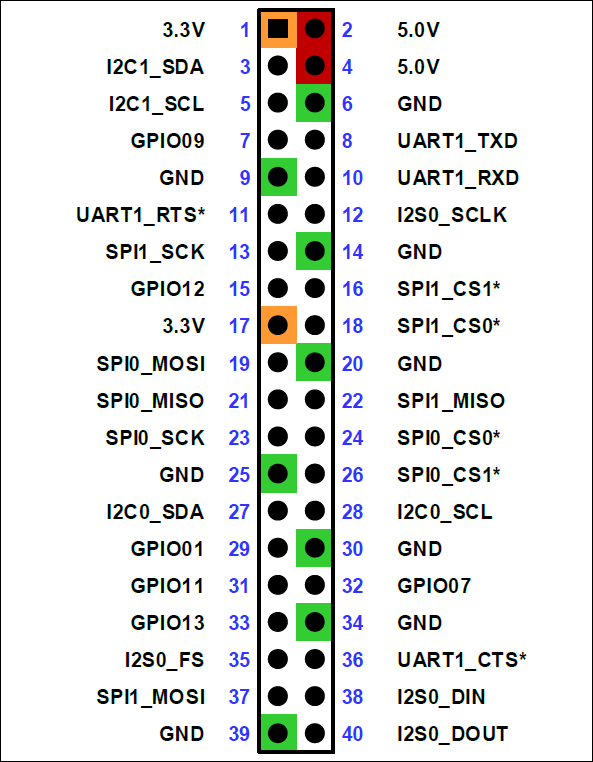
For ESP-Hosted over SPI, the header pins you care about most are:
- SPI1 MOSI: pin
19 - SPI1 MISO: pin
21 - SPI1 SCK: pin
23 - SPI1 CS0: pin
24 - SPI1 CS1: pin
26 - Ground: pins
6,9,14,20,25,30,34,39
This picture is useful because it keeps two different numbering systems separate:
- header pin numbers like
19and24, which are physical connector locations - Linux GPIO numbers like
471and433, which are kernel-visible IDs used by the driver helper
That distinction matters in real bring-up. You wire by header pin, but you debug the helper script and module parameters with Linux GPIO numbers.
The validated Jetson flow intentionally used:
resetpin=-1
That means the host driver does not drive ESP reset by default.
Why that mattered on real hardware:
- Jetson-driven reset could interfere with ESP boot
- it could also interfere with USB flashing from another host
- a manual ESP reset after module load proved more reliable
This is an Embedded Linux lesson many people miss:
- reset is not “just another GPIO”
- reset is a board-level control policy
You can still design a later automation path, but stable bring-up comes first.
Read:
esp_hosted_ng/host/Makefile
The most important detail is:
target ?= sdio- but Jetson bring-up uses
target=spi
So the actual module becomes:
esp32_spi.ko
The Makefile assembles:
- transport-specific sources:
spi/esp_spi.o
- common sources:
main.oesp_cfg80211.oesp_bt.oesp_cmd.oesp_utils.oesp_stats.oesp_debugfs.oesp_log.o
That split is exactly what you want to see in a portable Embedded Linux driver:
- one transport-specific module slice
- one mostly transport-agnostic Linux integration layer
The Makefile says that very directly:
target ?= sdio
MODULE_NAME := esp32_$(target)

ifeq ($(target), spi)
    ccflags-y += -I$(src)/spi -I$(CURDIR)/spi
    EXTRA_CFLAGS += -I$(M)/spi
    module_objects += spi/esp_spi.o
endif

module_objects += esp_bt.o main.o esp_cmd.o esp_utils.o \
                  esp_cfg80211.o esp_stats.o esp_debugfs.o esp_log.o

obj-m := $(MODULE_NAME).o
$(MODULE_NAME)-y := $(module_objects)
That tells you:
target=spichooses the transport glue- the Wi-Fi, Bluetooth, and lifecycle files are shared
- the final kernel object is assembled as
esp32_spi.ko
In the Jetson path, the helper script can unbind:
spi0.0fromspidev
Why this is necessary:
- the device tree exposed the SPI bus to Linux
- but the generic
spidevdriver may already own that SPI device - the real host module cannot use it cleanly until that generic binding is removed
This is a classic Embedded Linux pattern:
- first you prove the bus exists with a generic tool path
- then you disable the generic owner so the real subsystem driver can claim it
That is the difference between “bus visible” and “system integrated.”
The exact unbind step is short and very revealing:
if [ "$driver_name" = "spidev" ]; then
	echo "Unbinding ${spi_dev} from spidev for this boot..."
	echo "$spi_dev" | sudo tee /sys/bus/spi/drivers/spidev/unbind > /dev/null
	return
fi
This is a nice Embedded Linux lesson because the shell script is not “doing driver work.” It is clearing a device-model conflict so the real subsystem driver can reuse spi0.0.
Read:
esp_hosted_ng/host/main.cesp_hosted_ng/host/spi/esp_spi.c
The Jetson fork adds module parameters for:
resetpinclockspeedspi_bus_numspi_chip_selectspi_handshake_gpiospi_dataready_gpiospi_mode
Why this matters:
- the original board assumptions no longer have to be compiled in
- board mapping becomes a load-time decision
- debugging bus and GPIO problems becomes much faster
That is exactly how Embedded Linux code should evolve when it leaves a single-board tutorial phase.
The working Jetson load path was logically equivalent to:
sudo insmod ./esp32_spi.ko \
  resetpin=-1 \
  clockspeed=10 \
  spi_bus_num=0 \
  spi_chip_select=0 \
  spi_handshake_gpio=471 \
  spi_dataready_gpio=433 \
  spi_mode=2
What that tells you:
- this driver is board-aware at module load time
- the board-specific choices are separated from the compiled code
- the Linux subsystem integration does not need to know Jetson header pin numbers directly
Instead, the driver consumes:
- Linux SPI bus selection
- Linux chip select
- Linux legacy global GPIO numbers
That is exactly the level the kernel expects.
The helper constructs the final insmod arguments explicitly:
insmod_args=(
	resetpin="$RESETPIN"
	clockspeed="$CLOCKSPEED"
	raw_tp_mode="$RAW_TP_MODE"
	spi_bus_num="$SPI_BUS_NUM"
	spi_chip_select="$SPI_CHIP_SELECT"
	spi_handshake_gpio="$HANDSHAKEPIN"
	spi_dataready_gpio="$DATAREADYPIN"
	spi_mode="$SPI_MODE"
)

sudo insmod "$MODULE_NAME" "${insmod_args[@]}"
That is the practical handoff from board policy into the kernel module.
Answer these:
- Which settings in
jetson_orin_nano_init.share clearly board-specific? - Which settings are protocol-specific rather than board-specific?
- Why is
spidevunbinding a Linux integration problem, not just a shell-script problem? - Why is
resetpin=-1a reasonable default for bring-up?
Previous: Lecture 01 · Next: Lecture 03 — SPI transport and IRQs