Starlint is a high-performance, vanilla JavaScript utility designed to identify accessibility gaps and UI friction points in modern web interfaces. It specifically targets contrast ratios, interactive element scaling, and visual hierarchy to ensure a seamless experience for all users.
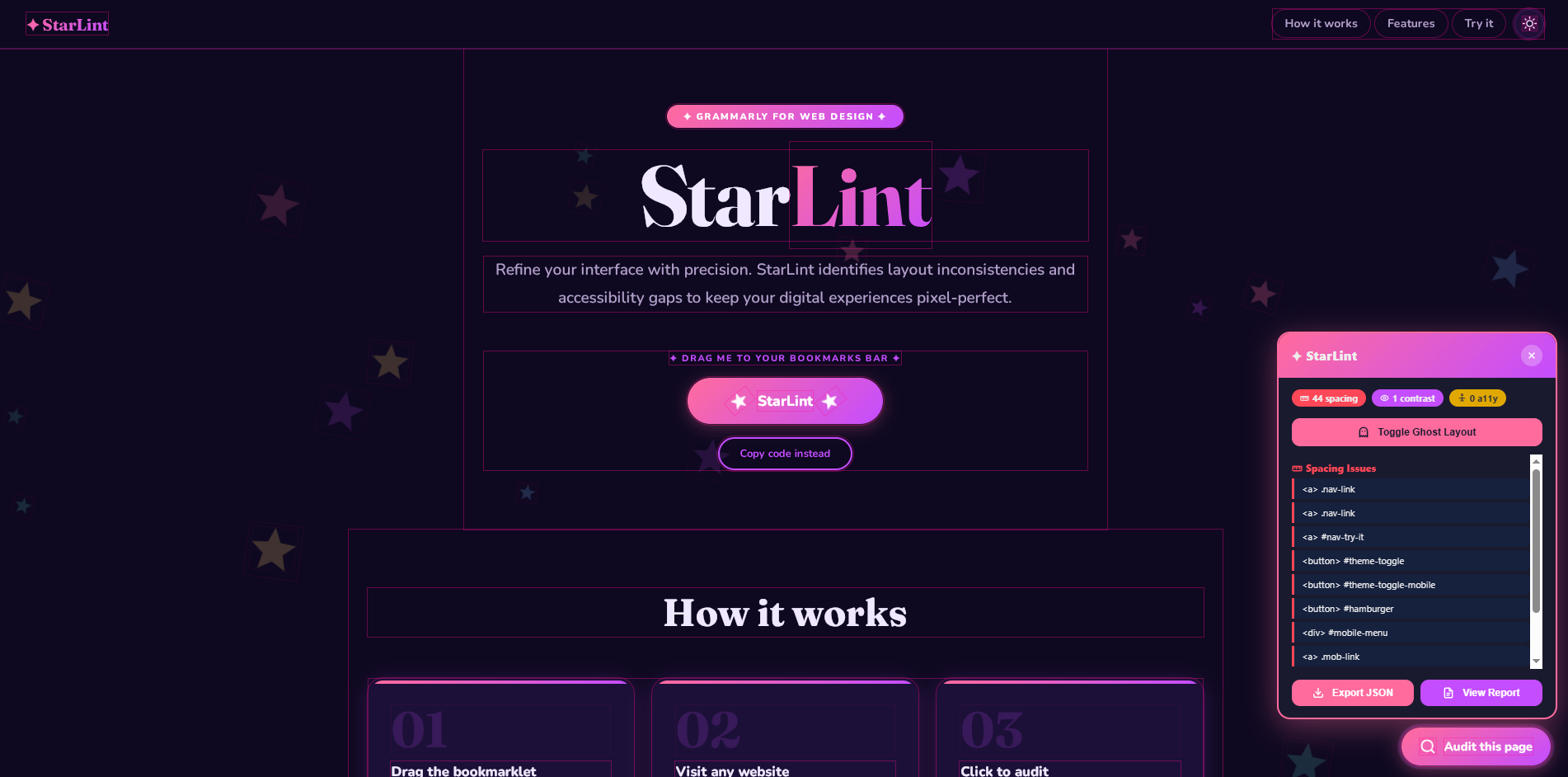
- Universal Bookmarklet Integration: Designed to run on any live website via the browser's bookmark bar, injecting the audit engine into the active DOM.
- Cross-Domain Compatibility: Engineered to handle varying site architectures without interfering with existing site scripts.
- Modular Architecture: Logic is decoupled into dedicated modules (Lint, UI, Theme) for high maintainability and scalability.
- Accessibility Check (A11y): Real-time auditing of DOM elements to detect low contrast and missing ARIA attributes.
- Zero-Dependency Core: Engineered entirely in Vanilla JS (ES6+) to ensure zero bloat and maximum execution speed.
- Visual Friction Analysis: Identifies elements that might cause "interaction fatigue" or visual overload in complex layouts.
-
Execution Method: JavaScript Bookmarklet (Browser-based injection)
-
Frontend: HTML5, CSS3 (Shadow DOM implementation for style isolation)
-
Logic: Vanilla JavaScript (Modular ES6+)
-
Deployment: Netlify (for hosting the remote script assets)
- Visit the live demo: https://starlint.netlify.app
- Drag the bookmarklet to your bookmarks bar or copy the code and paste it into a new bookmark’s URL field
- Open any website
- Click the bookmarklet to run the audit
Once installed, StarLint works on any website — just click the bookmarklet to see your audit report.
├── scripts/ # Core Auditor Engine (Modular ES6)
│ ├── lint.js # WCAG 2.1 auditing & accessibility logic
│ ├── ui.js # Dashboard injection & DOM manipulation
│ ├── theme.js # Glassmorphism & persistent state manager
│ └── script.js # Main initialization & event orchestration
├── style.css # Global auditor styles & responsive layout
├── index.html # Landing page / Documentation entry point
└── bookmarklet.js # The "Trigger" (Browser-side injection logic)
- Script Injection & Execution: The bookmarklet serves as a wrapper that triggers a dynamic script tag injection into the active document's .
- Remote Module Loading: Utilizing a lightweight loader, it fetches the modular ES6 logic (lint.js, ui.js, theme.js) from the Netlify-hosted CDN to ensure the latest version is always executed.
- DOM Traversal & Node Analysis: lint.js recursively traverses the active DOM tree, calculating WCAG 2.1 Contrast Ratios and identifying interactive elements lacking accessible names or ARIA roles.
- Shadow DOM Overlay (UI): To prevent style leakage from the host website, the auditor interface is rendered as a decoupled UI overlay, providing a non-destructive analysis dashboard.
- State Persistence: User-defined preferences are handled via localStorage, allowing the auditor's configuration to persist across different domains during a single session.
This project is licensed under the MIT License. See LICENSE for details.