EBRAINS is a powerful platform for advancing neuroscience. While it provides extensive support for rodent and human research, it currently includes only a single non-human primate (NHP) species. This is a significant shortfall, as NHPs are crucial for bridging the translational gap between rodent studies and human applications. To address this, the Marmoset@EBRAINS project aims to expand EBRAINS platform by introducing a new atlas of the marmoset (Callithrix jacchus) cerebral cortex, along with datasets covering neuronal distribution maps and cellular-level connectivity.
-
Datasets released over the course of the project:
- Nencki-Monash Template: Average Template of the Marmoset Cortex
- Probabilistic Localization of Cytoarchitectural Areas of the Nencki-Monash Average Template of the Marmoset Cortex
- Distribution of calbindin-positive neurons across areas and layers of the marmoset cerebral cortex
- Cellular Resolution Cortico-Cortical Connectome of the Marmoset Monkey
-
How did we contribute to the EBRAINS digital atlasing infrastructure:
-
How we made sure that the scientific community knows about the Marmoset@EBRAINS project:
The Marmoset@EBRAINS atlas is built upon the Nencki-Monash (NM) template, which represents a morphological average of 20 young adult marmosets. By using Nissl histology, this template combines the fine structural details found in histology-based atlases with the high-resolution, probabilistic approach typical of MRI templates. This framework is further enriched by comprehensive maps of cortical neurons and by results from 143 experiments involving injections of fluorescent retrograde tracers to map structural cortico-cortical connectivity. Additionally, we show how researchers can use existing EBRAINS tools to map their own datasets onto this new reference framework.
This work sets the stage for the marmoset to become a core model species within the EBRAINS ecosystem. By enabling more detailed cross-species comparisons and encouraging other research groups to contribute their own data, we hope to grow the EBRAINS community and make its digital atlasing toolkit even more versatile.
Throughout the project, we adjusted our approach, moving from an initial plan of three datasets to the final count of four. This change resulted from detailed discussions with the Data Curation Team. We realized that the Nencki–Monash Atlas of the Marmoset Cerebral Cortex would be much easier to manage if we presented it as two datasets. By splitting the atlas into two subsets, we were able to provide the anatomical template (the underlying anatomical imaging data) independently from the parcellation (division into neuroanatomical structures). This decision ensured that both components were as clear and organized as possible. Along with these, we provided the cortico-cortical structural connectome and the whole-brain density maps of Calbindin-positive (CB+) neurons in the common marmoset cerebral cortex.
Ultimately, these four datasets have been carefully compiled, curated, and added to the Knowledge Graph, creating a comprehensive digital map of the marmoset brain.
DOI: 10.25493/2DTR-F34
The Nencki–Monash (NM) template v1.0 (2020) represents a computational morphological average of 20 gender-balanced young adult brains of the common marmoset monkey (Callithrix jacchus), derived from 3D reconstructions based on Nissl-stained serial sections. The dataset includes a Nissl-like color anatomical reference rendered at 50 µm isotropic resolution, estimates of cortical thickness, and spatial transformations between the NM template and other selected marmoset brain templates to enhance interoperability. The template is embedded in stereotaxic coordinates, following the definition by Paxinos et al. (2012) (ISBN: 9780123978462). A more comprehensive description of the template creation process is available in Majka et. al. (2021).
Data curation request: 9 January 2025
Data descriptor submitted: 29 May 2025
Dataset released: 3 July 2025 (175 days)
Probabilistic Localization of Cytoarchitectural Areas of the Nencki-Monash Average Template of the Marmoset Cortex
DOI: 10.25493/RY2A-4Z1
This dataset introduces the probabilistic parcellation of cytoarchitectural cortical areas of the Nencki–Monash (NM) template. The NM template represents a computational morphological average of 20 gender-balanced young adult common marmoset monkey (Callithrix jacchus) brains, derived from 3D reconstructions based on Nissl-stained serial sections. For a detailed description of the computational process behind the template and a comprehensive description of its components, please refer to the template data descriptor (Majka et al., 2025) or the original publication Majka et al. (2021).
Data curation request: 9 January 2025
Data descriptor submitted: 25 June 2025
Dataset released: 25 July 2025 (197 days)
DOI: 10.25493/F2GC-RYK
The dataset contains three-dimensional whole-brain density maps of neurons expressing the calcium-binding protein Calbindin (CB+) from three common marmoset (Callithrix jacchus) monkeys. It also includes microscopic resolution images (×20 magnification, 0.5 µm/px) of individual immunostained sections. Quantitative estimates of CB+ densities are provided for 116 cortical areas currently recognized in the marmoset cerebral cortex, divided into supragranular, granular, and infragranular layers for each of the three individuals. The identification of CB+ neurons was performed automatically using a tailored convolutional neural network trained on the dataset examined. For each brain, the density maps, along with area and layer segmentations, are available as NIfTI files, while the high-resolution microscopic images are provided in TIFF format. Lastly, the dataset also provides tabulated results in an XLSX spreadsheet.
Data curation request: 9 January 2025
Dataset upload completed: 9 April 2025
Dataset descriptor submitted: 6 June 2025
Uploaded dataset validated: 13 October 2025
Dataset released: 1 December 2025 (326 days)
DOI: 10.25493/W52W-QCU
This dataset presents the results of 143 injections of fluorescent retrograde tracers in 53 brain hemispheres of the common marmoset (Callithrix jacchus) neocortex. Data obtained from different animals are registered in a common stereotaxic space. The dataset is available in various formats, facilitating a broad range of analyses. This includes, for instance, connectivity patterns relative to cytoarchitectural areas, featuring statistical properties such as the fraction of labeled neurons and the percentage of supragranular neurons. It also provides purely spatial (parcellation-free) data based on the stereotaxic coordinates of almost 2 million labelled neurons.
Data curation request: 9 January 2025
Dataset upload completed: 14 April 2025
Data descriptor prepared: 25 June 2025
Accepted for the final review: 12 September 2025
Dataset released: 8 December 2025 (334 days)
To enable the Marmoset@EBRAINS atlas and related features in the siibra toolsuite, we extended siibra explorer with the following functionalities:
- Support for a new species, custom scaling, and theming (PR #1485).
- Extended webstencils (ng-layer-tune to add additional colour maps for feature display (PR #9, PR #10).
We also updated the siibra-configuration repository with metadata related to the Marmoset@EBRAINS atlas:
- Created the necessary JSON files in the repository (PR #100) to enable the common marmoset as a species accepted by siibra explorer. The configuration includes elements related to the atlas, reference space, region parcellation, and segmentations of cortical areas.
We upgraded the siibra-python repository to support the new species and the related feature types:
- Patched siibra-python to support a new species, the common marmoset (PR #654).
- Extended the siibra-python tabular feature to use Plotly to visualize the interareal cortical-cortical connectivity map. On top of that, the new feature class has enabled additional, previously unsupported functionalities, such as links to external datasets (PR #685).
- In order to visualize the cortical Calbindin-positive neuronal density maps, we extended the siibra-python cell density profile (calbindin density) plugin to handle profiles of a large number of areas with proper caching and metadata (PR #694).
Upgraded neuroglancer-script to parse our research data and pre-compute the data package for siibra-explorer to load and display:
-
Patched neuroglancer-script (PR #46) to properly handle RGB NIfTI files (for both 3-tuple-based RGB data and structured object RGB format) and generate neuroglancer precomputed data bundles.
-
Created neuroglancer-formatted atlas templates, segmentation confidence, cell density maps, absolute and normalized cortical thickness maps, and brain model meshes, and uploaded them to the EBRAINS Collaboratory for public access.
Our primary contribution was to create and successfully merge the complete metadata definitions for the Marmoset Nencki-Monash (NM) template and parcellation into the openMINDS_SANDS module. This involved defining the BrainAtlas, CommonCoordinateSpace, and ParcellationEntity instances for a completely novel species from scratch (see PR #303).
In order to prepare suitable jsonld files, we created an automated script to read from our database and generate the metadata and the metadata version file. During this process, we identified a few unclear definitions of the jsonld schema, for instance, anatomicalAxesOrientation (defined as Structured information on the anatomical directions of the X, Y, and Z axis.), axesOrigin (defined as In openMINDS, axesOrigin is a property that specifies the origin (central point) of a Common Coordinate Space Version.). The definitions are very generic and it is hard for contributors to work out the exact reference point, unit and direction. We also identified inconsistency in license metadata, and additionally, we identified a few existing openMINDS registrations with incorrect license links and reported the errors to the openMINDS team (PR #334).
In general, adding a new species to OpenMINDS served as a stress test for the platform. The Marmoset@EBRAINS project highlighted some structural gaps in the openMINDS ecosystem (e.g. Issue #62) which emphasized the pressing need for automated validation tools so that external researchers can build and check their metadata without relying entirely on the small core curation team.
Another contribution to the EBRAINS digital atlasing infrastructure was enabling the microscopic resolution images (0.5 µm per pixel) of the Calbindin positive (CB+) neurons through EBRAINS online tool for sharing multi-resolution images: LocaliZoom. In total, 457 sections images (approximately 330 gigapixels of imaging data), have been shared through the tool. A prerequisite for enabling the images via LocaliZoom was registering them to the Marmoset@EBRAINS atlas using EBRAINS digital atlasing tools: QuickNII and Visualign. This process has been carried out for all three datasets which are now available under the links below:
Microscopic resolution image of Calbindin positive (CB+) neurons for:


Originally, we planned to prepare a peer-reviewed article quantitatively comparing the accuracy of different brain registration tools. This study was intended to use marmoset-specific pipeline from the Nencki Institute alongside species-agnostic EBRAINS software stack (QuickNii and Visualign) to map marmoset brain data and quantitavely compare the performance of both pipelines.
As the project progressed, delays in data curation and integration required more time than we had initially anticipated. After consulting with the Work Package 4 coordinator, we decided to pivot away from the article to ensure we could focus on our core tasks within the project’s timeline.
Despite this change in plans, the Nencki team continued to develop the necessary technical tools for as long as the project allowed. This effort resulted in reliable methods for comparing brain segmentations and a dedicated pipeline for registering the marmoset cortex to the Nencki-Monash template. Crucially, these methods were validated against "ground truth" data—manual brain maps created by an expert neuroanatomist. These outcomes are now publicly available in the integration_with_ebrains_registration_toolkit branch of this repository.
- Majka P., Bai S., Datta A., Łabuszewska K., Syc M., Walkiewicz T., Rosa M.G.P (2026). Expanding the EBRAINS digital atlasing ecosystem: integrating the common marmoset brain template. Neuronus Neuroscience Forum 2026. 24th-26th April 2026, Jagiellonian University Kraków, Poland.
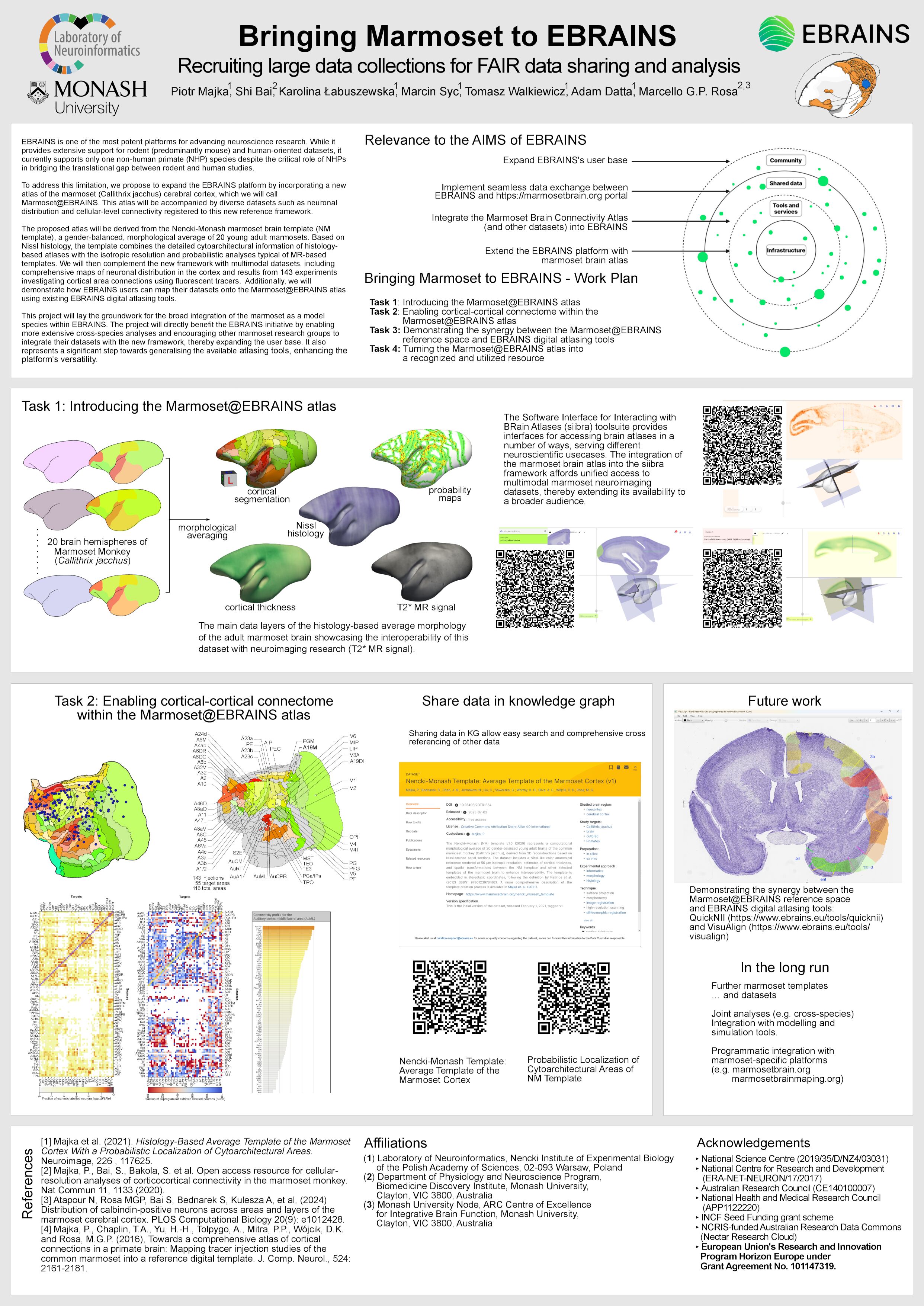
- Majka P., Bai S., Datta A., Łabuszewska K., Syc M., Walkiewicz T., Rosa M.G.P (2025). Bringing Marmoset to EBRAINS. 17th International Congress of the Polish Neuroscience Society, Wrocław, 2nd-5th September 2025, poster no. P2.45 (see the poster).
- Majka P. (2025) Getting the marmoset aboard EBRAINS - a case study. User talk at EBRAINS Summit, 10th December 2025, Brussels, Belgium (invited speaker).
- Majka P. (2025). Digital neuroanatomy, why and how? Cortico-cortical connectivity atlas of the common marmoset (Callithrix jacchus). Flash talk at PRIMatE Resource Exchange (PRIME-RE) Global Collaboration Forum, 4th–5th December 2025, online meeting.
- Majka P. (2025). Bringing Marmoset to EBRAINS (Marmoset@EBRAINS). EBRAINS Co-Design meeting, 10th June 2025, online meeting (invited speaker).
- Majka P. (2025). Digital neuroanatomy, why and how? 17th International Congress of the Polish Neuroscience Society, Wrocław, 3rd September 2025 (invited speaker during a plenary session).
19th February 2026
- https://ebrains.eu/news-and-events/2026/new-marmoset-brain-atlas-added-to-ebrains
- https://x.com/EBRAINS_eu/status/2024500316444479804
- https://www.linkedin.com/feed/update/urn:li:activity:7430266127756230656
- https://mastodon.social/@ebrains/116097914748192558
- https://bsky.app/profile/ebrains.bsky.social/post/3mf7ulwkjj22s
22nd December 2025
20 March 2025
17th International Congress of the Polish Neuroscience Society, Wrocław, 2-5 September 2025 abstract
P2.45. BRINGING MARMOSET TO EBRAINS
Piotr Majka (1,2), Shi Bai (2), Adam Datta (1), Karolina Łabuszewska (1), Marcin Syc (1), Tomasz Walkiewicz (1), Marcello G. P. Rosa (2)
(1) Laboratory of Neuroinformatics, Nencki Institute of Experimental Biology of the Polish Academy of Sciences, 02-093 Warsaw, Poland
(2) Biomedicine Discovery Institute and Department of Physiology, Monash University, Clayton, VIC 3800, Australia
INTRODUCTION: EBRAINS is one of the most potent platforms for advancing neuroscience research. While it provides extensive support for rodent (predominantly mouse) and human-oriented datasets, it currently supports only one non-human primate (NHP) species despite the critical role of NHPs in bridging the translational gap between rodent and human studies.
AIM(S): To address this limitation, we propose to expand the EBRAINS platform by incorporating a new atlas of the marmoset (Callithrix jacchus) cerebral cortex, which we will call Marmoset@EBRAINS. This atlas will be accompanied by diverse datasets such as neuronal distribution and cellular-level connectivity registered to this new reference framework.
METHOD(S): The proposed atlas will be derived from the Nencki-Monash marmoset brain template (NM template), a gender-balanced, morphological average of 20 young adult marmosets. Based on Nissl histology, the template combines the detailed cytoarchitectural information of histology-based atlases with the isotropic resolution and probabilistic analyses typical of MR-based templates. We will then complement the new framework with multimodal datasets, including comprehensive maps of neuronal distribution in the cortex and results from 143 experiments investigating cortical area connections using fluorescent tracers. Additionally, we will demonstrate how EBRAINS users can map their datasets onto the Marmoset@EBRAINS atlas using existing EBRAINS digital atlasing tools.
CONCLUSIONS: This project will lay the groundwork for the broad integration of the marmoset as a model species within EBRAINS. The project will directly benefit the EBRAINS initiative by enabling more extensive cross-species analyses and encouraging other marmoset research groups to integrate their datasets with the new framework, thereby expanding the user base. It also represents a significant step towards generalising the available atlasing tools, enhancing the platform's versatility.
FINANCIAL SUPPORT: This project is co-funded by the European Union's Horizon Europe Research Infrastructures programme under grant agreement no. 101147319 (EBRAINS 2.0) and by the National Science Centre (2019/35/D/NZ4/03031).
User talk: Bringing Marmoset to EBRAINS
Piotr Majka (1)
(1) Laboratory of Neuroinformatics, Nencki Institute of Experimental Biology of the Polish Academy of Sciences, 02-093 Warsaw, Poland
The Marmoset@EBRAINS project focused on expanding the EBRAINS research infrastructure by incorporating a digital atlas of the common marmoset brain. This effort is driven by the marmoset's growing importance as a primate model for bridging the translational gap between human and rodent studies in neuroscience. At the same time, the project serves as a real-world test of the platform's core principles: flexibility, interoperability, and extensibility.
Piotr Majka (1,2), Shi Bai (2), Adam Datta (1), Karolina Łabuszewska (1), Marcin Syc (1), Tomasz Walkiewicz (1), Marcello G. P. Rosa (2)
(1) Laboratory of Neuroinformatics, Nencki Institute of Experimental Biology of the Polish Academy of Sciences, 02-093 Warsaw, Poland
(2) Biomedicine Discovery Institute and Department of Physiology, Monash University, Clayton, VIC 3800, Australia
EBRAINS is a leading platform for advancing neuroscience research, providing extensive support for rodent and human-oriented datasets. However, it currently supports only one non-human primate (NHP) species, despite the critical role NHPs play in bridging the tranlational gap between rodent models and human studies. From a technical standpoint, the platform lacks a standardized procedure for incorporating atlases of additional animal species.
To address this limitation, we propose extending the EBRAINS platform by integrating an atlas of the common marmoset brain, termed Marmoset@EBRAINS project. The atlas is accompanied with additional datasets, including neuronal distribution and cellular-level connectivity. Additionally, we demonstrate how EBRAINS users can map their own datasets onto the atlas using the platform's digital atlasing tools.
The proposed atlas is derived from the Nencki-Monash marmoset brain template, a morphological average of 20 marmoset brains. The template combines high-resolution cytoarchitectural information with the isotropic resolution of MR-based templates. The atlas is implemented via Siibra-Explorer, the native EBRAINS atlas browser, while accompanying datasets were curated using the OpenScienceData workflow.
We implemented the Marmoset@EBRAINS atlas as a hosted resource on the platform. To facilitate this integration, we also extended the Siibra-Explorer plugin system to support features specific to our atlas. Further, we provided four curated, FAIR-compliant datasets that are fully integrated into the EBRAINS Knowledge Graph and registered with the openMINDS metadata framework.
This project lays the foundation for integrating the marmoset as a model species within EBRAINS. By providing a framework that enables other research groups to contribute data, it substantially broadens the platform’s potential user base. Finally, this work marks an important step toward generalizing EBRAINS’ atlasing tools and increasing the platform’s versatility.
EBRAINS 2.0 (101147319, Financial Support to Third Parties, FSTP)
National Science Centre (2019/35/D/NZ4/03031)