





I design, build, test, and ship production software — from early product decisions through to reliable delivery.
Tokyo, Japan · Founder at BizBeam
I turn operational problems into focused software products. My work spans product discovery, interface design, full-stack engineering, automation, testing, deployment, and the documentation needed to keep systems maintainable.
I am currently focused on native developer tools, privacy-conscious web products, SaaS platforms, and upstream performance and reliability work across projects including Ollama, OpenTelemetry Go, Charmbracelet Crush, and PyInstaller.
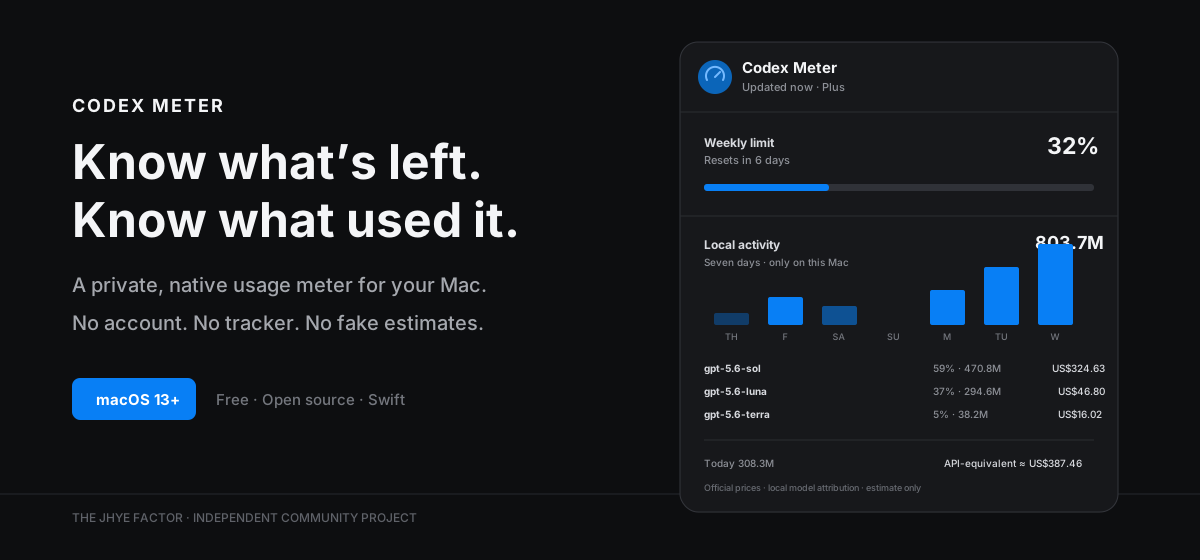
Codex Meter is a free, open-source macOS menu bar app for monitoring Codex limits, reset times, local model usage, and API-equivalent cost estimates.
- Native Swift 6 application for Apple silicon and Intel Macs
- Local-first activity analysis with no analytics service or external database
- Honest stale and error states instead of invented usage estimates
- Scriptable CLI, CI validation, and automated release workflow
- MIT licensed with downloadable community builds
Source code · Latest release · Architecture
- Coalesced high-rate chat stream updates, reducing React Query cache commits from 200 to 51 in a deterministic stream test while preserving immediate first output and final state.
- Closed a first-byte download-stall gap, added race-tested regression coverage, and removed a fixed completion polling tail measured at 1.001 seconds down to 689.5 microseconds in the scoped local benchmark.
- Added retries for interrupted model-manifest pulls, covering failures before response headers and mid-body disconnects without increasing healthy-path allocations.
Moved language-server relevance filtering ahead of PATH lookup, avoiding thousands of unnecessary filesystem checks for unrelated servers. In the controlled 300-server discovery benchmark, median time fell from 50.82 ms to 308.61 µs, allocated memory fell 238×, and allocations fell 96×. The change includes regression tests, race builds, linting, and CPU/allocation profile evidence.
Added a compile-only cross-build workflow covering Go 1.25 and 1.26 across 14 target platforms. The change introduces a 28-job matrix, a stable aggregate check, and a Make target that validates foreign GOOS/GOARCH combinations without trying to execute cross-compiled test binaries.
Documented macOS Finder launch context and bundle-safe resource handling, including writable-state placement and a reproducible diagnostic workflow. Validation included a warnings-as-errors Sphinx build and a signed windowed application launched through macOS LaunchServices.
Codex Meter is maintained as a public MIT-licensed product with native Swift source, CI, release automation, architecture documentation, and downloadable builds. The current public release is v1.5.0.
The upstream pull requests above are under maintainer review. Benchmark figures describe the linked controlled test harnesses, not whole-application speedups.
| Product | Engineering focus | Links |
|---|---|---|
| CareerLift | Privacy-first resume and cover-letter workflows, browser persistence, live preview, and document export | Source · Live product |
| PDF Power Tools | Client-side PDF splitting, merging, OCR, annotation, signatures, redaction, and compression without document uploads | Source · Live product |
| WebOS | Browser desktop environment with window management, terminal emulation, applications, and a persistent virtual filesystem | Source · Live product |
| jhye.dev | Responsive product portfolio with structured content, documented architecture, automated checks, and static deployment | Source · Live site |
Product engineering: TypeScript, React, Next.js, JavaScript, Node.js, Firebase, Firestore
Native and systems: Go, Swift, Python, macOS application development, networking, CLI tooling, packaging
Performance and reliability: deterministic benchmarks, pprof, benchstat, race detection, regression testing
Quality and delivery: automated testing, GitHub Actions, cross-platform CI/CD, Docker, Vercel, GitHub Pages
Product practice: workflow design, UX systems, accessibility, technical writing, production readiness
- Start with the operating problem and the people who have to use the product.
- Prefer clear workflows and maintainable systems over unnecessary complexity.
- Treat testing, security, accessibility, documentation, and deployment as part of the build.
- Make claims that can be supported by working software, source code, or validation evidence.
Contribution activity

Open to thoughtful engineering collaborations and product-focused opportunities.