A complete chess engine written entirely in pure TeX (~2,100 lines of TeX macros) created by Claude Code and Mathieu Acher.
All game logic (board representation, move generation, legal move validation, search, and evaluation) runs inside TeX at compile time. No Lua, no external programs for the chess logic itself. Just \count registers, \csname tables, and a lot of \expandafter.
To the best of our knowledge, this is the first chess engine ever written in LaTeX/TeX.
Estimated strength: ~1300 Elo (measured: 46% score vs Stockfish 1320 over 100 games, time control 40/60+1).
Playable on Overleaf and locally via pdflatex recompilation.
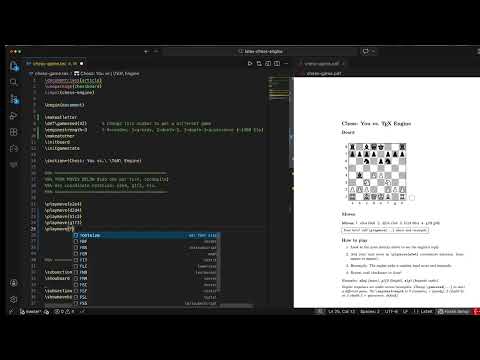
Local usage — Playing against the engine locally via pdflatex recompilation
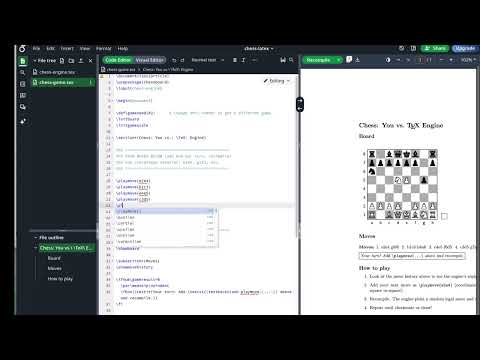
Overleaf demo — Running the engine directly in Overleaf (yes, it works... you might need to change depth by setting \enginestrength=2 or 1 or 0... play locally)
- Complete chess rules: castling, en passant, promotion, check/checkmate/stalemate detection
- Depth-3 negamax search with alpha-beta pruning
- Quiescence search (1-ply captures) at leaf nodes
- Piece-square tables (Simplified Evaluation Function)
- MVV-LVA move ordering
- 4 strength levels: random, greedy, depth-2, depth-3 + quiescence
- UCI protocol support for tournament play against other engines
- Interactive terminal mode
- Test suite (23 assertions covering move generation, evaluation, search, and game rules)
Edit chess-game.tex — add your moves as \playmove{e2e4} lines, then recompile:
pdflatex chess-game.texThe engine responds automatically. Open the PDF to see the board, move history, and game status. Add another \playmove{...} and recompile for the next turn.
Configuration (in chess-game.tex):
\def\gameseed{42}      % Change for a different game
\enginestrength=3 % 0=random, 1=greedy, 2=depth-2, 3=depth-3+quiescencebash chess-interactive.shPlay in the terminal with a text board display. Enter moves in coordinate notation (e2e4, g1f3). Type help for commands.
python3 chess-uci.pyThe UCI wrapper lets the engine play in tournaments via cutechess-cli or any UCI-compatible GUI.
| File | Description |
|---|---|
chess-engine.tex |
The engine (~2,100 lines of TeX) |
chess-game.tex |
Play-by-recompile document |
chess-test.tex |
Test suite |
chess-uci.py |
UCI protocol bridge (Python) |
chess-uci.tex |
UCI-mode TeX document |
chess-interactive.sh |
Interactive terminal mode |
run-elo-test.sh |
Tournament runner (vs Stockfish) |
pgn2latex.py |
PGN to LaTeX book converter |
- Board:
\countregisters 200–263 (one per square, a1=index 1, h8=index 64) - Piece encoding: 1=wP, 2=wN, 3=wB, 4=wR, 5=wQ, 6=wK; negatives for black
- Search: 3-ply negamax + 1-ply quiescence, alpha-beta pruning, MVV-LVA move ordering
- Evaluation: material + piece-square tables (384
\csnameentries precomputed at load time) - State stack:
\count10000+registers for make/unmake move (9 values per depth) - File/rank lookups: precomputed
\csnametables to avoid\numexprrounding pitfalls - Speed: ~1–3 seconds per move at depth 3
pdflatex chess-test.texCheck the log output for PASS/FAIL results:
grep -E "PASS|FAIL" chess-test.logRequires cutechess-cli, Stockfish, and Python 3:
bash run-elo-test.shConfiguration via environment variables:
GAMES=100 STOCKFISH_ELO=1320 TIME_CONTROL="40/60+1" bash run-elo-test.sh- pdfLaTeX (any TeX distribution: TeX Live, MiKTeX)
- chessboard LaTeX package (for board display in PDFs — not needed for engine logic)
- For tournaments: Python 3, cutechess-cli, Stockfish
This engine was entirely AI-generated using Claude Code (agentic coding). Mathieu Acher guided the process through iterative prompting; the TeX code itself was written by Claude.