This site is a short introduction to the National Clinical Terminology Service (NCTS) in Australia, focusing on the very basics. Overviews and introductions to Clinical Terminology, its purpose and use cases, and the related software to store, extend and send terminology is covered here. Efforts have been made to include Quick Starts, Examples and References to validated information sources for newcomers. Click the headings below to expand a section of content. Follow the included links for more in-depth information (these will open in the same tab by default).
This is a lightweight "website" that's easy to update and share. If you open the README.md file directly then you will see:
* A left-hand navigation menu that is a folder/file explorer
* A right-hand contents menu that shows the headings in the file that is open (needs a click to expand)
You can also use browser finding (e.g., CTRL-F, CMD-F) to keyword search the file that is open. Note this only searches the current page, not the entire site.
This microsite is run by James Grant ( james.grant@csiro.au ) to support the accessibility and approachability of the NCTS and its services and offerings. It is not a substitute for the NCTS website and its documentation and guides which includes more comprehensive and detailed information. It is intended that if you've recently met one of the NCTS team then this is an initial overview to outline selected core concepts before progressing to richer materials.
Formal contact with the NCTS via the Australian Digital Health Agency is available by emailing help@digitalhealth.gov.au.
Clinical Terminology is essentially a dictionary of terms with mutually understood meanings that enable consistent communication in healthcare.
To illustrate, think of an English dictionary: it contains words and definitions that allow authors to write countless books. Each book is unique, and the words appear in different orders, yet readers can understand them - or look them up - because they share the same dictionary. Readers can even reuse words from one book to write another chapter or compare texts.
Similarly, a Clinical Terminology provides a shared set of words or terms for the health system to document patient records. This common vocabulary makes it easier to share, search, and compare records within and across systems.
Every clinical or health information system relies on terminology - it is impossible to record anything without words. The goal is to adopt a single, standardised source of terminology to improve shared understanding across the health system to reduce duplicate efforts and data entry and support improved patient experiences and outcomes.
In Australia, the primary general-purpose Clinical Terminology is SNOMED CT (Systematized Nomenclature of Medicine – Clinical Terms). Much of the material provided by the NCTS focuses on the Australian edition, SNOMED CT-AU (which includes the Australian Medicines Terminology (AMT), though it is not the only terminology in use.
Though it's easy to presume there's a deliberate separation of terminology and terms and knowledge.
Explore as much as you like and you will not find a direct line between "chest pain" (a finding/symptom) and "myocardial infarction" (a disorder/diagnosis). A clinical terminology is limited to describing all the "stuff" that goes into clinical care and surrounding environment. It does not contain health "knowledge" - such that chest pain could be a sign of a myocardial infarction. That knowledge is captured in training programs, dedicated knowledgebases and decision support systems.
More recent standards are being trialled on providing standardised, structured knowledge patterns that uses clinical terminology as input and can provide information and decision support back.
A Terminology Server is a specialised software service that manages, publishes, and supports the use of clinical terminologies. It acts as a central, authoritative service for clinical concepts representing diagnoses, procedures, medications, laboratory tests, observations and more. This helps ensure that these concepts or terms are represented and understood consistently across systems and health settings.
In practice, a terminology server stores standardised vocabularies (for example, SNOMED CT-AU, LOINC, or medication terminologies), along with their definitions, relationships, and versions. It provides operations or functions that allow clinical systems to look up codes, retrieve human-readable descriptions and translate between different coding systems where required.
The primary value of a terminology server is consistency and interoperability. By using a shared service rather than individual code lists, healthcare organisations reduce ambiguity, support accurate data exchange, and enable safer clinical decision-making. Terminology servers also simplify maintenance by managing updates and changes centrally, helping digital health systems remain aligned with evolving clinical standards while supporting analytics, reporting, and secondary uses of data.
To recap the above benefits for clinical terminology and terminology servers:
- Consistency: the "dictionary" of terms being available across the continuum of systems within and alongside health organisations and solutions
- Interoperability: more organisations and solutions are using nationally or internationally recognised terminology vocabularies allowing concepts sent out to be understood by other systems and incoming concepts to be understood by the local system
- (there's a related messaging/exchange standard to this known as "FHIR" though that's to have an introduction written a little later on)
These seemingly smaller and simpler outcomes of using standardised clinical terminology and server systems multiplies to more specific outcomes:
- Less Maintenance: particularly across large or multiple solutions the "clinical jargon" is one spot and updates synchronise through
- Larger Markets: the entire globe is moving towards standardised terminologies and separating clinical terminology into a terminology server separate to a core system(s) means changing the terminology source can be enough to try a solution in a new region
- Easier Tinkering: developed on well-established web standards with a mature community there are lots of references to learn from, people to talk with, and exploration can all occur from within a single web browser (some browser terminology Getting Started samples below!)
There are also next-generation solutions beyond initial implementation and embedding: clinical decision support systems fed by local and non-local information, complex analytics using the ontological and meta-data of a full clinical terminology and allowing higher quality artificial intelligence (AI) methods through access to standardised (cleaner) training and run-time data
The purpose of the following QuickStarts is to showcase the first steps in interacting with SNOMED CT-AU and demystify it. It's a comprehensive system with plenty to learn and the intent here is see what it is first (and understand it better, later).
So, let's dive in and see what it's all about!.
Clinical terminology is about detail and richness. The CSIRO has developed a visualiser for terminology so users can "see" what that means (which is essentially a concept of interest connected to all the elements to which it is related).
This image is a snapshot of the term 'labetalol', a heart medication, and where it sits within the structure of SNOMED CT-AU:

Open this for yourself (you will need to agree to usage terms and conditions if you're a first time user of the Shrimp Browser.
The elements on the (1) side are 'higher' up the structure. Labetalol is considered an adrenergic receptor antagonist, a beta blocker and is derived from Ethanolamine. Clicking any of those elements (which are concepts too) will show you what is related to them in turn.
The elements on the (2) side are 'lower' down the structure. As a concept, labetalol comes in a combined product with hydrochlorothiazide, comes as itself only, comes in an oral dose form and comes in a parenteral (injectable) form. Clicking any of those elements will show you what's related to those (which become increasingly specific concepts eventually ending in what physically exists).
The link above goes directly to the labetalol concept in Shrimp. To find a different medication use the search field and type whatever you like!

99% of the time all you need to do to see if something exists in SNOMED CT-AU or find out how it connects in the system (and therefore what it is related to) is type if into the search field (1) as soon as Shrimp opens.
The other 1% might mean changing the CodeSystem (2) to something else. For example, LOINC - a pathology and laboratory reference - is another popular terminology in use.
SNOMED CT-AU contains over 700,000 clinical terms at the time this microsite has been written and there's plenty more than medications in there!
Let's use this example to also illustrate how different concept types should be used in different parts of a clinical information system. Searching for "chest pain" displays the following:
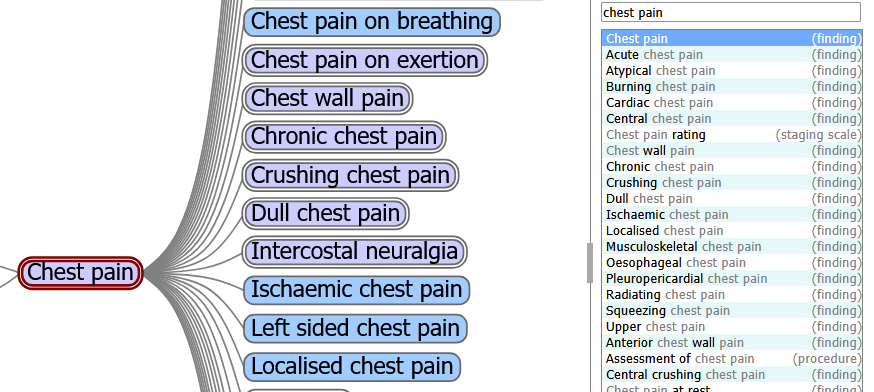
Direct link to open the chest pain concept in Shrimp
SNOMED CT-AU has many more detailed concepts for chest pain to enable healthcare professionals and health teams to record with specificity what is or has happened in a patient's history.
A nuance here is that "chest pain" has a concept type of "Finding". It's distinct to a diagnosis that a doctor/medical professional may end up making after the patient described having chest pain.
If the health professional determine the patient has had a "heart attack" then a set of clinical terms to describe that exist:
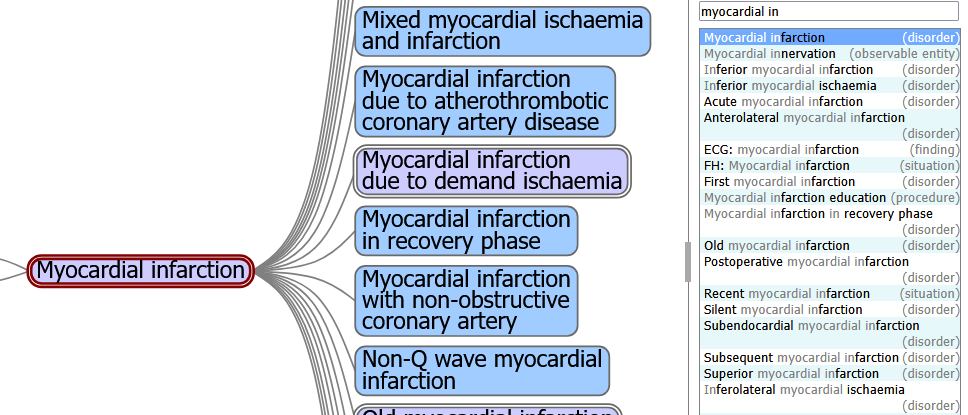
Direct link to myocardial infarction concept in Shrimp.
This example showcases an additional facet of the NCTS' Ontoserver hosted copy of SNOMED CT-AU.
- Most clinical terms have Synonyms that are recognised during searching or filtering. Typing in "heart attack" will find the same concept as "myocardial infarction".
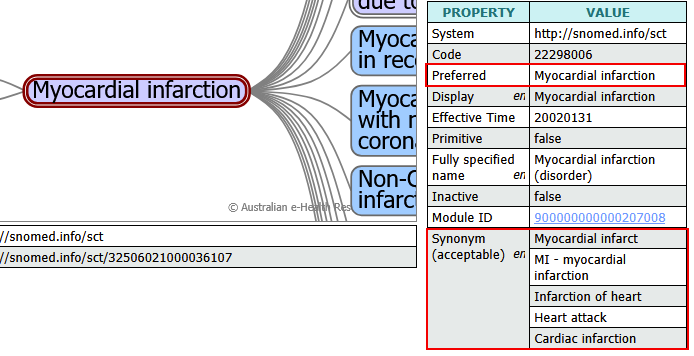
All the data that is used to generate the visuals in Shrimp is available as tables or structured responses from the NCTS service (or your own terminology server).
The first foray you should have is downloading the tables of data from the NCTS website. If you don't have a username and password yet follow the prompts to Register - accounts for health-related use cases in Australia are free.
Once logged in there's a lot of information there. Let's start with finding the myocardial infarction (heart attack) disorder in a Reference Set (refset) table. Navigating through the menus: [Access clinical terminology > SNOMED CT-AU > Search reference sets] will take you to a filterable search. Type in 'disorder' and the top hit is "Clinical finding foundation reference set." Clicking the "LATEST" button opens the download view and you can choose what specific format you'd like to use.
If you're at the stage where you want to skip the graphical and deal in purer data then the NCTS' FHIR Terminology Server (Ontoserver) has an open endpoint to enable that. Using the reference set id seen above the following API call will retrieve the same file in a JSON format. This link will work in your browser (though it may render more nicely in a platform like Postman): https://tx.ontoserver.csiro.au/fhir/ValueSet/$expand?url=http://snomed.info/sct?fhir_vs=refset/32570071000036102
Even if you're not technical I encourage you to copy and paste this URL into your browser - it just works! One of the benefits to building Australia's clinical terminology with the adjacent Standard, FHIR^, in mind - it adopts general web compliant queries and responses.
^Fast Healthcare Interoperable Resources (_a topic that will have a brief introduction available in the next release_)
Example of the browser-based return seen at time of writing:
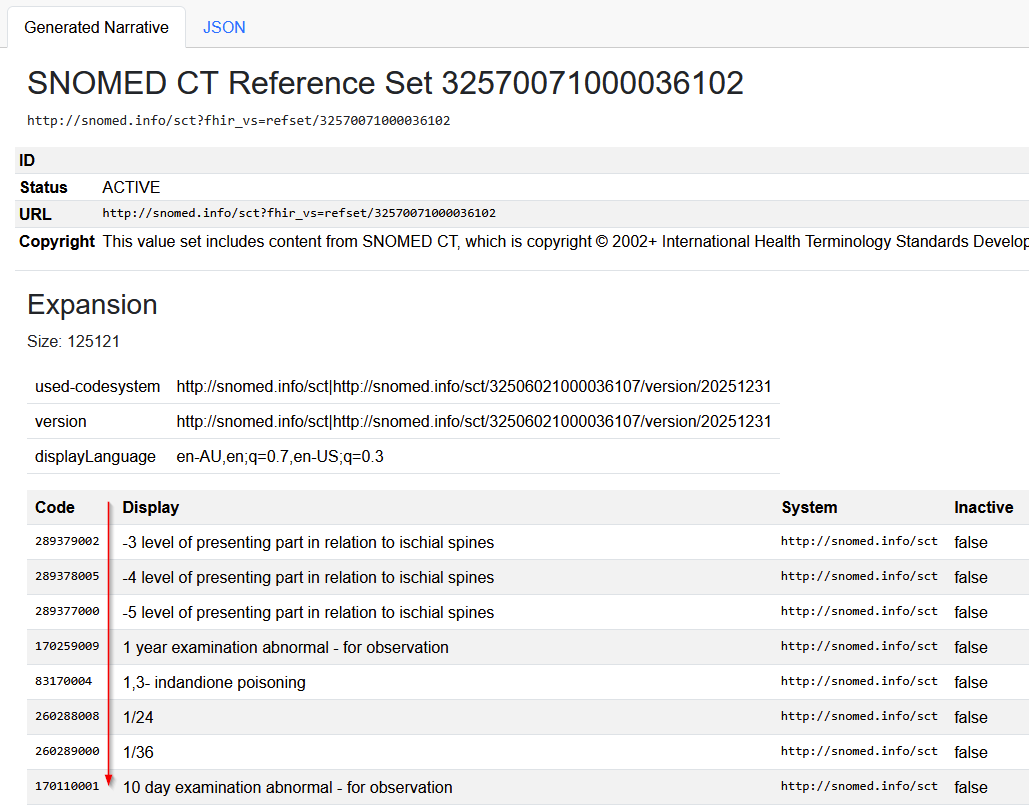
This short introduction is only the beginning of working with the NCTS' Clinical Terminiology service and offerings.
If you'd like to read more about the NCTS and the topics covered here then visit the full NCTS website.
If reading isn't quite enough then please contact us! The NCTS team is happy to answer questions and provide guidance as our vision is enhancing healthcare delivery in Australia by streamlining the adoption and effective use of clinical terminology, enabling improved patient safety, data interoperability, and healthcare outcomes. Email the team anytime at help@digitalhealth.gov.au and more information or time to meet can be scheduled so we can help and support you.
This is a summary of the links provided throughout this site.
- This README.md file (ideal view)
- The NCTS website
- NCTS email (help@digitalhealth.gov.au)
- CSIRO (Commonwealth Scientific and Industrial Research Organisation)
- Australian Digital Health Agency
- SNOMED CT (Systematized Nomenclature of Medicine – Clinical Terms)
- Shrimp SNOMED CT-AU Visualiser
- FHIR (Fast Healthcare Interoperable Resoruces)
A rolling list of questions asked of the NCTS during our engagements.
Taxonomies classify; Ontologies specify.
A taxonomy is like a filing system - it puts things into categories so they’re easy to find. For example, the Dewey Decimal System groups books by topic, and biology groups animals into classes like mammals or reptiles.
Ontologies go deeper: they define how those categories work, what relationships exist, and what rules apply. Think of an ontology as the blueprint for organising information - it says what kinds of things exist and how they connect.
In healthcare: ICD is a taxonomy - it classifies diseases into codes. SNOMED CT is an ontology - it defines clinical concepts, their attributes, and relationships for richer, structured data.
Thus there is a push to use ontologies (clinical terminology) in clinical information systems so the most precise and information-rich concept is used. Taxonomies (classifications) almost always sacrifice richness or nuance for simplicity.
Learn more about taxonomies vs ontologies from this article.
The NCTS website is the place to go and can be found here.
It includes far more information than this microsite on topics such as each of the Terminologies supported by the NCTS, details on what the team does, and both video and written documentation about terminology and the related technologies.
# License
Copyright (c) 2026 Commonwealth Scientific and Industrial Research Organisation (CSIRO) ABN 41 687 119 230.
All materials are licensed under the Creative Commons Attribution 4.0 International License (CC-BY). You may obtain a copy of the CC-BY license at: https://creativecommons.org/licenses/by/4.0/legalcode