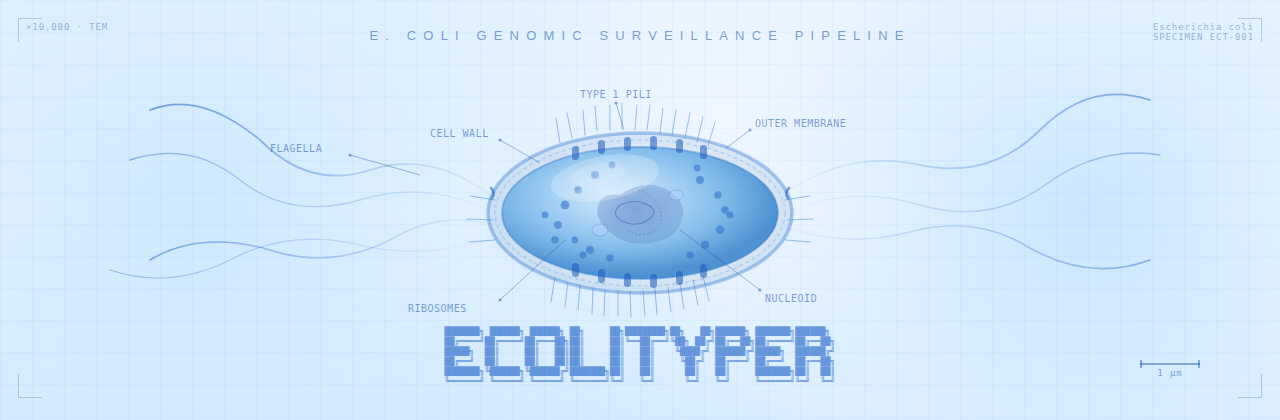
🧬 A species-optimized computational pipeline for comprehensive genotyping and surveillance of Escherichia coli
Complete E. coli genomic analysis in minutes — not hours











Perfect for clinical microbiology, outbreak investigations, and genomic research.
- 🌟 Overview
- ✨ Core Features
- 🛠️ Installation
- 🎯 Usage Examples
- 📊 Output Structure
- 🎨 Interactive Report Features
- 🔗 Integrated External Tools & Dependencies
- 🤖 AI Integration Guide
- 🌍 EcoliDB Lineage Database
- ⚡ Performance Benchmarks
- 🆚 Competitive Comparison
- 📚 Citation
- ❓ Frequently Asked Questions
- 🤝 Contributing
- 🐛 Issue Reporting
⚠️ Limitations & Considerations- 📜 License & Third-Party Components
- 👥 Authors & Affiliations
- 🙏 Acknowledgements
- 🔮 Future Development Roadmap
- 📞 Support & Community
EcoliTyper is a revolutionary bioinformatics pipeline designed to eliminate workflow fragmentation in E. coli genomic surveillance. By integrating seven core genotyping analyses into a single automated workflow, EcoliTyper transforms disconnected genomic data into coherent biological narratives with actionable public health intelligence.
"From fragmented analysis to integrated insight in one command"
| Traditional Workflow 😫 | EcoliTyper Solution 🎉 |
|---|---|
| 7+ independent tools required | Single unified pipeline |
| Manual data integration & synthesis | Automated cross-genome pattern discovery |
| Hours of manual curation | Intelligent risk assessment & alerting |
| Disconnected epidemiological context | Integrated lineage database of high-risk clones |
| Multiple output formats to reconcile | Consolidated HTML report + structured data (TSV/JSON) |
| Complex installation & dependencies | Self-contained Conda package |
Key Achievement: Processes 30 E. coli genomes in ~41 minutes on 16 CPU cores with perfect concordance against reference tools.
- 🧬 Multi-Locus Sequence Typing (MLST) – Achtman scheme with PubMLST database
- 🔍 In silico Serotyping – O and H antigen determination via SerotypeFinder (≥90% coverage/identity)
- 🎯 CH Typing – High-resolution fumC/fimH typing for fine-scale discrimination
- 🌳 Clermont Phylogrouping – Evolutionary context with 2013 scheme (8 phylogroups)
- 💊 Antimicrobial Resistance Profiling – Dual screening via ABRicate (9 databases) & NCBI-AMRFinderPlus
- 🦠 Virulence Factor Detection – Comprehensive pathogenicity assessment
- 📊 Plasmid Replicon Typing – Mobile genetic element characterization
- 🔬 Cross-genome pattern discovery – Automated gene frequency analysis & distribution mapping
⚠️ Rule-based clinical risk assessment – Hierarchical alerting (CARBAPENEMASE > ESBL > COLISTIN-RES)- 🌍 Integrated lineage database – Manually curated reference of high-risk clones (ST131, ST1193, etc.)
- 📈 Population-level insights – Immediate epidemiological overview of resistance cassettes & virulence profiles
- 🚀 Hybrid parallel execution – Inter-module & intra-module parallelization
- 🎛️ Dynamic resource allocation – Automatic scaling with genome complexity
- ⚖️ Memory-aware processing – Strategic sequential execution for resource-intensive operations
- 🔄 Robust error handling – Graceful recovery with checkpointing & automated cleanup
# Create and activate environment
conda create -n ecolityper -c conda-forge -c bioconda -c bbeckley-hub ecolityper -y
conda activate ecolityperIf you prefer a containerized environment or cannot install Conda, use our Docker image. It includes all dependencies and pre‑configured databases – no setup required. Run the complete E. coli typing pipeline with zero installation – just Docker.
docker pull bbeckleyhub/ecolityper:latestdocker run --rm -v $(pwd):/data bbeckleyhub/ecolityper:latest -i "/data/genome.fna" -o /data/outputAfter the run, output files are owned by root on your host. To reclaim ownership:
sudo chown -R $USER:$USER ./outputdocker run --rm -v $(pwd):/data bbeckleyhub/ecolityper:latest -i "/data/*.fna" -o /data/outputdocker run --rm -v $(pwd):/data bbeckleyhub/ecolityper:latest [ECOLITYPER_OPTIONS]--rm: remove container after exit-v $(pwd):/data: mount current directory to/datainside container- Input files must be under
/data(e.g.,/data/*.fna) - Output directory must also be under
/data(e.g.,/data/output)
docker run --rm -v $(pwd):/data bbeckleyhub/ecolityper:latest \
  -i "/data/*.fna" -o /data/output \
--threads 8 --skip-visualizationdocker run --rm -v $(pwd):/data bbeckleyhub/ecolityper:latest \
-i "/data/*.fna" -o /data/output -t 16By default, Docker runs as root inside the container. Any files written to your mounted directory will be owned by root:root.
You have three options:
sudo chown -R $USER:$USER ./outputCurrently not fully supported because EcoliTyper needs to write to its own installation directory. A future update will fix this.
See the Singularity section below.
docker run --rm bbeckleyhub/ecolityper:latest -hdocker run --rm --entrypoint /bin/bash bbeckleyhub/ecolityper:latest -c "abricate --list | head -5"Expected output: list of databases (ncbi, card, vfdb, etc.)
On HPC clusters that support Singularity/Apptainer, you can run EcoliTyper without sudo and output files will be owned by your user automatically.
Important: EcoliTyper writes temporary files inside its own installation directory (e.g.,
/opt/ecolityper/...). Singularity mounts containers as read‑only by default, so you must add the--writable-tmpfsflag to allow these writes. The flag creates an ephemeral, writable overlay in memory – no permanent changes are made to the container.
singularity pull ecolityper.sif docker://bbeckleyhub/ecolityper:latest
singularity run --writable-tmpfs -B $(pwd):/data ecolityper.sif -i "/data/*.fna" -o /data/outputIf you encounter TLS timeouts or other network errors (common on some HPCs), convert an existing Docker image to a Singularity SIF file on a machine with Docker, then transfer the .sif file to the HPC.
Step 1 – on a machine with Docker (e.g., your laptop):
docker pull bbeckleyhub/ecolityper:latest
docker save bbeckleyhub/ecolityper:latest -o ecolityper.tar
singularity build ecolityper.sif docker-archive://ecolityper.tar
Now copy ecolityper.sif to your HPC home or project directory (e.g., using scp).
Step 2 – on the HPC (no sudo needed):
singularity run --writable-tmpfs -B $(pwd):/data ecolityper.sif -i "/data/*.fna" -o /data/output| Flag | Purpose |
|---|---|
--writable-tmpfs |
Creates a temporary writable overlay – required for EcoliTyper to write intermediate files to /opt/... |
-B $(pwd):/data |
Binds your current directory to /data inside the container (input files are read from here, output is written here) |
-i "/data/*.fna" |
Input pattern – use quotes to prevent shell expansion on the host |
-o /data/output |
Output directory (will appear as ./output on your host) |
You can use any EcoliTyper flag, e.g.:
singularity run --writable-tmpfs -B $(pwd):/data ecolityper.sif \
-i "/data/*.fna" -o /data/output --threads 8 --skip-visualizationAfter a successful run, you will see output indicating each module completed. All result files in ./output will be owned by your HPC user – no sudo chown needed.
All releases are available at:
https://hub.docker.com/r/bbeckleyhub/ecolityper
git clone https://github.com/bbeckley-hub/EcoliTyper.git
cd EcoliTyper
conda env create -f environment.yml
conda activate ecolityper
pip install -e .- Minimum: 2 CPU cores, 8 GB RAM
- Recommended: 8+ CPU cores, 16+ GB RAM for batch processing
- OS: Linux, macOS, or Windows (WSL2 recommended for Windows)
ecolityper -i genome.fasta -o results_directory/# Process all FASTA files in current directory
ecolityper -i "*.fasta" -o batch_results --threads 8
# Process specific pattern
ecolityper -i "GCF_*.fna" -o surveillance_run --threads 16# Skip specific modules for faster processing
ecolityper -i isolates/ -o quick_typing --skip-amrfinder --skip-visualization
# Minimum typing only
ecolityper -i sample.fna -o basic_results --skip-lineage --skip-summaryusage: ecolityper [-h] -i INPUT -o OUTPUT [-t THREADS] [--skip-amrfinder]
[--skip-abricate] [--skip-mlst] [--skip-serotyping]
[--skip-chtyper] [--skip-phylogrouping] [--skip-lineage]
[--skip-summary] [--skip-visualization]
EcoliTyper: Complete E. coli Typing Pipeline
optional arguments:
-h, --help show this help message and exit
-i INPUT, --input INPUT
Input FASTA file(s) - can use glob patterns like "*.fna" or "*.fasta"
-o OUTPUT, --output OUTPUT
Output directory for all results
-t THREADS, --threads THREADS
Number of threads (default: 2)
--skip-amrfinder Skip AMRfinderPlus analysis
--skip-abricate Skip ABRicate analysis
--skip-mlst Skip MLST analysis
--skip-serotyping Skip serotyping analysis
--skip-chtyper Skip CH typing analysis
--skip-phylogrouping Skip phylogrouping analysis
--skip-lineage Skip lineage reference generation
--skip-summary Skip summary report generation
--skip-visualization Skip visualization generation
Examples:
ecolityper -i genome.fna -o results/
ecolityper -i "*.fna" -o batch_results --threads 8
ecolityper -i "*.fasta" -o analysis --threads 16 --skip-lineage
ecolityper -i "genome*.fa" -o results/ --threads 4
Supported FASTA formats: .fna, .fasta, .fa, .fsa
Analysis Modules:
• MLST (Multi-Locus Sequence Typing)
• Serotyping (O and H antigen determination)
• CH Typing (FumC and FimH typing)
• Phylogrouping (Clermont algorithm)
• ABRicate (Resistance/Virulence/Plasmid screening)
• AMRfinderPlus (NCBI AMR gene detection)
• Lineage reference database
• Summary Reports (HTML summary reports)
• Visualizations (Charts and visualizations)
Output: Comprehensive results for all analyses in organized directories
results_directory/
├── 📄 abricate_results/              # Multi-database screening (CARD, ResFinder, VFDB, etc.)
│   ├── ecoli_*_summary.json         # Consolidated JSON summaries
│   ├── ecoli_*_summary_report.html  # Interactive HTML reports
│   └── per_sample/                  # Individual genome results
├── 🔬 amrfinder_results/             # NCBI AMRFinderPlus outputs
│   ├── ecoli_amrfinder_summary.tsv
│   ├── ecoli_amrfinder_summary_report.html
│   └── per_sample/
├── 🎯 chtyper_results/               # High-resolution CH typing
│   ├── chtyper_results.tsv
│   ├── chtyper_results.html
│   └── per_sample/
├── 🧬 mlst_results/                  # Multi-Locus Sequence Typing
│   ├── mlst_summary.tsv
│   ├── mlst_summary.html
│   └── per_sample/
├── 🌳 phylogrouping_results/         # Clermont phylogrouping
│   ├── phylogrouping_results.tsv
│   ├── phylogrouping_results.html
│   └── per_sample/
├── 🔍 serotyping_results/            # O:H antigen typing
│   ├── serotype_analysis_report.tsv
│   ├── serotype_analysis_report.html
│   └── per_sample/
├── 🌍 lineage_results/               # Epidemiological context
│   └── ecoli_comprehensive_reference.html
├── 📈 summary_results/               # Consolidated reports
│   └── GENIUS_ULTIMATE_REPORTS/
│       ├── genius_ultimate_report.html     # Main interactive report
│       ├── genius_ultimate_report.json
│       ├── amr_genes.csv
│       ├── virulence_genes.csv
│       └── pattern_discovery.csv
└── 🎨 visualization_results/         # Publication-ready figures
    └── ECOLI_VISUALIZATIONS/
        ├── PDF/     # Vector graphics
        ├── PNG/     # Raster images
        ├── SVG/     # Scalable vector graphics
        └── DATA/    # Source data for figures
See a complete interactive report generated by EcoliTyper:

The report includes AMR and virulence gene tables, filter buttons, combination tables, and FASTA QC metrics.
- Sample Overview: Quick glance at typing results across all genomes
- Risk Alert Panel: Automatic flagging of high-priority resistance markers
- Epidemiological Context: Lineage information for identified clones
- Gene Frequency Tables: Prevalence of AMR/virulence genes across population
- Pattern Discovery: Identification of common resistance cassettes
- Distribution Maps: Visual representation of gene carriage
- Stacked Bar Charts: MLST, serotype, and phylogroup distributions
- Violin Plots: Quantitative metrics distribution
- Pie Charts: Phylogroup and serotype proportions
- Heatmaps: Gene presence/absence patterns
EcoliTyper integrates several powerful open-source tools and databases. These are not bundled directly in this repository. Instead, they are automatically installed as dependencies via Conda (as defined in environment.yml). The MIT license that applies to the EcoliTyper pipeline code does not cover these external tools. Each tool is used under the terms of its own license, and we gratefully acknowledge their authors.
| Tool/Database | Purpose | Source | License |
|---|---|---|---|
| MLST | Multi-locus sequence typing | tseemann/mlst | GPL v2 |
| ABRicate | Mass screening for resistance/virulence | tseemann/abricate | GPL v2 |
| AMRFinderPlus | AMR gene detection | ncbi/amr | Public Domain |
| SerotypeFinder | O:H antigen typing | CGE | Apache 2.0 |
| CHTyper DB | fumC/fimH typing | CGE | Free for research |
| ezClermont | Phylogrouping | https://github.com/nickp60/ezClermont | MIT |
| Database | Purpose | License |
|---|---|---|
| CARD | Comprehensive antibiotic resistance | Free for research |
| ResFinder | Acquired antimicrobial resistance | Free for research |
| NCBI | NCBI bacterial AMR reference | Public Domain |
| ARG-ANNOT | Antibiotic resistance gene annotation | Free for research |
| MEGARES | Comprehensive resistance database | Free for research |
| VFDB | Virulence factors | Free for research |
| EcoH | E. coli hemolysins | Free for research |
| Ecoli_VF | E. coli virulence factors | Free for research |
| PlasmidFinder | Plasmid replicons | Free for research |
EcoliTyper generates comprehensive HTML reports that are perfect for AI analysis. Here's how to use AI tools to get more from your data.
- Install any AI browser extension (ChatGPT, Claude, Gemini)
- Open your report:
genius_ultimate_report.html - Select text in any section (AMR Genes, MLST Analysis,Serotype analysis, CH type etc.)
- Right-click → Ask AI with your question
For MLST Analysis:
- "What is the clinical significance of ST21 vs ST10?"
- "Which ST-Serotype-Phylogrouping-CH types combinations are hypervirulent?"
For AMR Genes:
- "Explain the OmpA gene and its importance"
- "Which samples have multiple resistance genes?"
- "What treatment implications do these genes have?"
For Virulence Factors:
- "Which samples carry espK?"
- "Are there any high-risk virulence combinations?"
For Pattern Discovery:
- "Are there correlations between ST and specific genes?"
- "Identify any concerning patterns in this dataset"
For Publication & Manuscript Summary:
- Select the sample overview section and ask AI "Summarize the population overview for my E. coli results"
SUPER-TRICK FOR CHATGPT & CLAUDE AI USERS:
- Upload the
genius_ultimate_report.htmlreporter and ask any question in any section. - From interaction to insights in minutes...."Summarize the Sample overview section as the First results for my Manuscript"
- Provide context: "I'm analyzing E. coli genomics data..."
- Be specific: Instead of "tell me about this", ask "what does ST21 O26:H11-B1-fumC4:fimH440 combination indicate?"
- Ask for interpretations: "What are the clinical implications of these findings?"
- Request summaries: "Summarize the resistance profile of sample XYZ"
EcoliTyper reports are structured with clear tables and organized data that AI can easily understand. Each gene is shown with all genomes that contain it, making pattern analysis straightforward.
"AI provides powerful insights but always verify critical findings with domain experts."
EcoliTyper includes EcoliDB, a manually curated comprehensive reference database for rapid E. coli lineage contextualization. This database associates sequence types with clinical pathotypes, serotypes, and risk profiles to inform public health analysis.
- 12 Sequence Types with detailed epidemiological profiles
- 13 Pathotypes categorized (Diarrheagenic, Extraintestinal, Hybrid, Animal, Mucosal)
- 13 Serotypes with clinical associations
- 8 Phylogroups according to Clermont scheme
- 4 Carbapenemase Types for resistance profiling
- 79 Scientific References supporting the data
| Sequence Type | Risk Level | Primary Pathotype | Key Features |
|---|---|---|---|
| ST131 | VERY HIGH | UPEC/ExPEC | Global MDR pandemic clone, CTX-M-15, fluoroquinolone resistance |
| ST1193 | HIGH | UPEC/ExPEC | Emerging fluoroquinolone-resistant, community-associated UTIs |
| ST95 | VERY HIGH | NMEC/ExPEC | Neonatal meningitis, high virulence, O18:H7 serotype |
| ST405 | VERY HIGH | ExPEC | Global MDR, carbapenemase producers (OXA-48, NDM) |
| ST410 | VERY HIGH | ExPEC | Emerging MDR, OXA-181/NDM-5 carbapenemases |
| ST648 | VERY HIGH | Zoonotic MDR | Pan-drug resistance emerging, significant One Health concern |
| ST11 | VERY HIGH | EHEC | O157:H7, hemorrhagic colitis, HUS risk |
| ST10 | LOW-MODERATE | Commensal/Pathogenic | Diverse genetic background for horizontal gene transfer |
| ST117 | MODERATE | APEC | Avian pathogenic, poultry industry concern |
| ST69 | HIGH | Hybrid UPEC/EAEC | Uropathogenic/diarrheagenic hybrid |
| ST73 | HIGH | Classic UPEC | Community-associated UTIs, high virulence |
| ST88 | HIGH | NMEC/ExPEC | Meningitis-associated, less common than ST95 |
The lineage database is automatically generated during analysis and can be found at:
lineage_results/ecoli_comprehensive_reference.html
This interactive HTML file provides:
- Search functionality by sequence type, serotype, or resistance profile
- Risk categorization (HIGH, MODERATE, LOW)
- Geographical distribution maps
- Treatment recommendations based on resistance profiles
- Key references for each lineage
| Scenario | Genomes | Time | Hardware | Speed per Genome |
|---|---|---|---|---|
| Standard Workstation | 30 genomes | 80-150 min | 2 CPU cores, 8GB RAM | 3-6 min |
| High-Performance Server | 30 genomes | 41 min | 16 CPU cores, 16GB RAM | 1.2 min |
| Single Genome | 1 genome | 1-6 min | Variable | - |
- 100% concordance with standalone reference tools (mlst, SerotypeFinder, ezClermont)
- Perfect typing of reference strains (K-12 MG1655, O157:H7, O18ac:H7)
- Robust performance across diverse clinical and reference isolates
| Feature | EcoliTyper | ECTyper | Bactopia | Mykrobe |
|---|---|---|---|---|
| Primary Focus | E. coli integrated genotyping | E. coli serotyping | Multi-species generalist | AMR prediction |
| MLST | ✅ Achtman scheme | ❌ | ✅ | ❌ |
| Serotyping | ✅ O:H (SerotypeFinder) | ✅ | Limited | ❌ |
| CH Typing | ✅ fumC/fimH | ❌ | ❌ | ❌ |
| Clermont Phylogrouping | ✅ 2013 scheme | ❌ | ✅ | ❌ |
| AMR Profiling | ✅ ABRicate + AMRFinderPlus | Limited | ✅ AMRFinder | ✅ Core function |
| Virulence Screening | ✅ 9 databases | Shiga toxins only | Limited | ❌ |
| Cross-genome Analysis | ✅ Automated pattern discovery | ❌ | ❌ | ❌ |
| Lineage Database | ✅ Curated high-risk clones | ❌ | ❌ | ❌ |
| Output Formats | HTML, TSV, JSON, text | Various | Various | Various |
| Installation | ⚡ Single Conda package | Moderate | Complex (Nextflow) | Simple |
| Typing Speed (30 genomes) | 41 minutes | N/A | ~120 minutes | N/A |
Reference Tools:
- Mykrobe: https://github.com/Mykrobe-tools/mykrobe
- Bactopia: https://github.com/bactopia/bactopia
- ECTyper: https://github.com/phac-nml/irida-plugin-ectyper
If you use EcoliTyper in your research, please cite:
@software{beckley2025ecolityper,
  title = {EcoliTyper: A species-optimized computational pipeline for comprehensive genotyping and surveillance of Escherichia coli},
  author = {Beckley, B. and Amarh, V.},
  year = {2025},
  publisher = {GitHub},
  journal = {GitHub repository},
  howpublished = {\url{https://github.com/bbeckley-hub/EcoliTyper}},
  doi = {10.5281/zenodo.17761775}
}EcoliTyper integrates several third-party tools. Please cite them when using corresponding modules:
Serotyping & CH Typing
@article{joensen2015rapid,
  author = {Joensen, K. G. et al.},
  title = {Rapid and easy in silico serotyping of Escherichia coli using whole genome sequencing data},
  journal = {Journal of Clinical Microbiology},
  year = {2015}
}

@article{roer2018chtyper,
  author = {Roer, L. et al.},
  title = {CHTyper, a web tool for subtyping of extraintestinal pathogenic Escherichia coli},
  journal = {Journal of Clinical Microbiology},
  year = {2018}
}
ABRicate & MLST (Torsten Seemann)
@software{seemann_abricate_2018,
  author = {Seemann, T.},
  title = {ABRicate: Mass screening of contigs for antimicrobial resistance and virulence genes},
  year = {2028},
  publisher = {GitHub},
  url = {https://github.com/tseemann/abricate}
}
@software{seemann_mlst_2018,
  author = {Seemann, T.},
  title = {MLST: Scan contig files against traditional PubMLST typing schemes},
  year = {2018},
  publisher = {GitHub},
  url = {https://github.com/tseemann/mlst}
}
AMR (NCBI)
@article{feldgarden2019validating,
  author = {Feldgarden, M. et al.},
  title = {Validating the AMRFinder Tool and Resistance Gene Database},
  journal = {Antimicrobial Agents and Chemotherapy},
  year = {2019}
}
Phylogrouping
@article{waters2020easy,
  author = {Waters, N. R. et al.},
  title = {Easy phylotyping of Escherichia coli via the EzClermont web app},
  journal = {Access Microbiology},
  year = {2020}
}Q: What makes EcoliTyper different from other typing tools? A: EcoliTyper is specifically optimized for E. coli and integrates 7 complementary typing methods into a single pipeline with automated cross-genome pattern discovery and a curated lineage database for epidemiological context.
Q: Can I use EcoliTyper for other bacterial species? A: No, EcoliTyper is specifically optimized for Escherichia coli. The algorithms, thresholds, and databases are tailored for this species.
Q: How much disk space is required? A: Approximately 5-10 GB for the Conda environment and databases. Additional space is needed for input genomes and output files.
Q: How accurate is EcoliTyper compared to standalone tools? A: EcoliTyper shows 100% concordance with standalone reference tools (mlst, SerotypeFinder, ezClermont) for standard typing methods on validated reference strains.
Q: What should I do if I find a novel sequence type not in the database? A: Please report it as a GitHub issue with supporting references. We actively maintain and expand the lineage database.
We welcome contributions from the community! Here's how you can help:
- 🍴 Fork the repository
- 🌿 Create a feature branch (
git checkout -b feature/amazing-feature) - 💾 Commit your changes (
git commit -m 'Add amazing feature') - 🚀 Push to the branch (
git push origin feature/amazing-feature) - 🔔 Open a Pull Request
Areas for Contribution:
- Database expansion and curation
- Additional typing schemes
- Performance optimizations
- Visualization enhancements
- Documentation improvements
The EcoliTyper pipeline code (the workflow engine, report generation, HTML templates, and Python modules written by the authors) is licensed under the MIT License – see the LICENSE file for details.
EcoliTyper executes several external bioinformatics tools, which are installed as Conda dependencies. Each tool is the property of its respective developers and is used under its own license:
| Tool | License |
|---|---|
| MLST (Torsten Seemann) | GPL v2 |
| ABRicate (Torsten Seemann) | GPL v2 |
| AMRFinderPlus (NCBI) | Public Domain |
| SerotypeFinder (CGE) | Apache 2.0 |
| CH Typing databases (CGE) | Free for research |
| ezClermont | MIT |
By using EcoliTyper, you agree to comply with the licenses of these third-party tools and databases.
-
Brown Beckley – Creator & Lead Developer Department of Medical Biochemistry, University of Ghana Medical School, Accra, Ghana Department of Biochemistry and Biotechnology, Kwame Nkrumah University of Science and Technology, Kumasi, Ghana 📧 brownbeckley94@gmail.com
-
Dr. Vincent Amarh – Supervisor & Advisor Department of Medical Biochemistry, University of Ghana Medical School, Accra, Ghana
- Regular database updates
- Enhanced visualization capabilities
- Improved documentation and tutorials
- Integration with raw read analysis pipelines
- Real-time database update mechanisms
- Cloud deployment options (Docker, Singularity)
- AI/ML models for predictive analytics
- Web interface for non-command-line users
- Expanded lineage database with global collaborations
- Integration with public health surveillance systems
Transforming fragmented genomic surveillance into integrated public health intelligence 🧬✨
"From sequences to surveillance in one command"
Join the Fight Against Antimicrobial Resistance
Antimicrobial resistance (AMR) represents one of the most significant global health threats of our time. We invite researchers, clinicians, and public health professionals to collaborate with us in expanding and validating our E. coli database, sharing regional epidemiological data, and advancing AMR surveillance.
Together, we can enhance global AMR monitoring and develop more effective treatment strategies.

