LLM-judge scores are cheap, plentiful, and miscalibrated. In our benchmark, naive 95% confidence intervals built on raw judge scores contained the true value 0% of the time. CJE calibrates your judge against a small slice of ground truth (5–25% of samples), evaluates your policies at scale, and reports uncertainty you can defend — including telling you when not to trust the result.







pip install cje-evalGenerate responses from each candidate policy on a shared prompt set, judge everything, and attach ground-truth labels (oracle_label) to the slice you can afford — human raters, expert review, a downstream KPI. Any bounded scale works (0–1, 0–100, Likert). CJE needs at least 10 labeled rows pooled across policies — they can all come from one policy, and even that policy doesn't need labels on every row:
from cje import analyze_dataset

# One policy carries the oracle slice — CJE learns the judge→oracle mapping
# once and applies it to every unlabeled response, in any policy. Coverage
# is never required to be complete: gpt-5.6 has 20 responses with labels on
# only 10 (oracle_label=None means unlabeled); fable-5 has no labels at all.
labeled = [(0.62, 0.55), (0.68, 0.60), (0.72, 0.70), (0.76, 0.74), (0.79, 0.75),
           (0.83, 0.80), (0.85, 0.90), (0.88, 0.92), (0.91, 0.88), (0.95, 0.97)]
unlabeled = [0.64, 0.69, 0.73, 0.77, 0.80, 0.84, 0.87, 0.89, 0.92, 0.94]
judge_only = [0.70, 0.74, 0.75, 0.78, 0.81, 0.83, 0.86, 0.90, 0.93, 0.94]

results = analyze_dataset(
    fresh_draws_data={
        "gpt-5.6": [
            {"prompt_id": f"q{i:02d}", "judge_score": s, "oracle_label": y}
            for i, (s, y) in enumerate(labeled + [(u, None) for u in unlabeled])
        ],
        "fable-5": [
            {"prompt_id": f"q{i:02d}", "judge_score": s}
            for i, s in enumerate(judge_only)
        ],
    }
)

for policy, estimate, (lo, hi) in zip(
    results.metadata["target_policies"], results.estimates, results.ci()
):
    print(f"{policy:15s} {estimate:.3f}  95% CI [{lo:.3f}, {hi:.3f}]")
fable-5 0.811 95% CI [0.751, 0.873]
gpt-5.6 0.784 95% CI [0.589, 0.844]
fable-5 gets a calibrated estimate and an honest CI without a single label of its own, and gpt-5.6's ten unlabeled rows are covered by the same transfer — labels are a pooled budget, not a per-row requirement. That transfer is what the labels-under-every-policy workflow wastes money re-buying.
And when the data can't support an answer, CJE says so instead of handing you a confident number. Here a candidate policy's judge scores land mostly outside the range where the calibrator saw oracle labels — the run emits the paper's coverage badge and refuses level claims for that policy:
REFUSE-LEVEL for policy 'candidate': 88.3% of fresh-draw judge scores fall
outside the oracle calibration range [0.161, 0.595]. Do not ship level
(absolute) claims for this policy; rankings may stand. Collect oracle labels
covering the missing score range.
The cje analyze CLI takes the same gates into account before crowning a winner:
⚠️ Best by point estimate: candidate (UNRELIABLE — see diagnostics)
🏆 Best reliable policy: baseline
→ Runnable Colab with real data · Full docs
| Your situation | Use |
|---|---|
| Rank/compare policies using an LLM judge, with some ground-truth labels | CJE |
| One dataset, labels sampled from it, want a CI on its mean | PPI works; CJE's calibrated_mean_ci is the same primitive and adds the transport audit + coverage badge |
| Evaluate many policies without labeling under each — and know when calibration reuse breaks | CJE (the transport audit is the point) |
| Predict how a specific response will score | Not CJE — per-item prediction (conformal methods) |
| Off-policy estimates from logs only (importance weighting / doubly robust) | pip install "cje-eval==0.3.*" — the frozen OPE line; 0.4.x is Direct-mode only (see Notes on 0.4.0) |
- Calibrate: learn the judge → oracle mapping on the labeled slice (isotonic, two-stage when needed; mean-preserving by construction; cross-fitted).
- Evaluate: score every policy's fresh responses through the calibrated judge and compare policies on the same prompts.
- Audit & refuse: a transport audit per policy (does the calibration still hold on this policy's outputs?) and a coverage badge for level claims (were there oracle labels where this policy's scores live?). Failing gates change the output — they are not footnotes.
Confidence intervals account for the judge being learned from a finite label budget (calibration-aware inference), not just sampling noise.
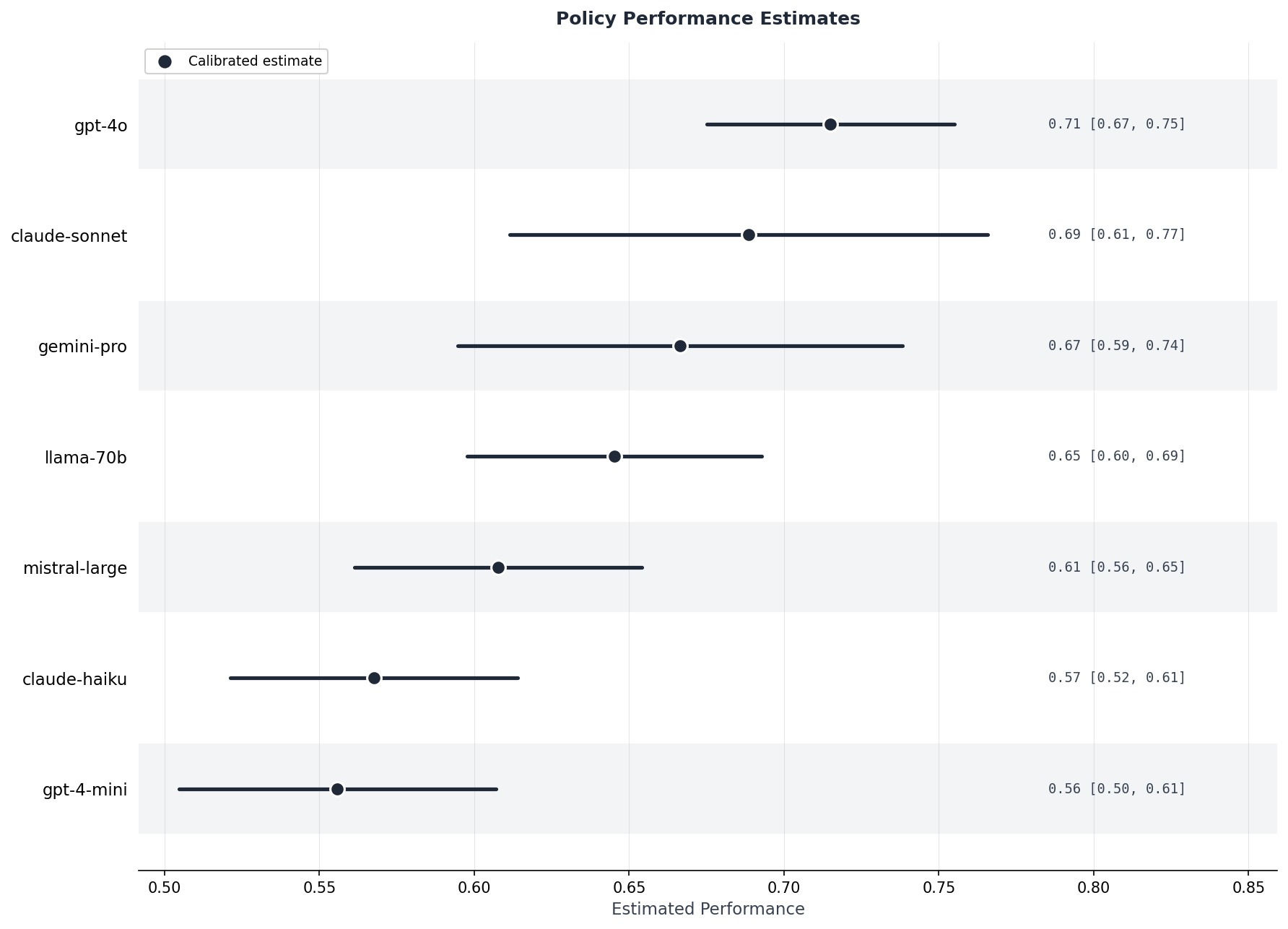
Calibrated estimates with 95% CIs (valid under the calibration and transport checks CJE runs by default)
- HealthBench (physician labels, n=29,511): two LLM judges were overconfident by 24.5 and 13.0 points and disagreed with each other by up to 73 points on specific criteria categories. Calibrated on 5% physician labels (~1,400 records), both converged to the physician ground truth. Read the full audit →
- Chatbot Arena (4,961 prompts, 5 policies): 99% pairwise ranking accuracy at a 5% oracle fraction — 14× cheaper than labeling everything, with ~95% CI coverage vs 0% for naive judge-score CIs. An adversarial policy that fools the judge is correctly flagged by the transport audit. Paper →
calibrated_mean_ci is the library's bottom layer — a ppi_py-style primitive that takes plain numpy arrays and returns a calibrated mean with an honest CI. Use it when you have one sample of judge scores and a partial oracle slice; use analyze_dataset for multi-policy comparisons.
import numpy as np
from cje import calibrated_mean_ci

rng = np.random.default_rng(0)
scores = rng.uniform(size=400)                      # judge scores for every sample
labels = np.full(400, np.nan)                       # NaN = unlabeled
labeled = rng.choice(400, size=100, replace=False)  # oracle slice (25%)
labels[labeled] = np.clip(scores[labeled] + rng.normal(0, 0.1, size=100), 0, 1)

result = calibrated_mean_ci(scores, labels)
print(result.summary())
Calibrated mean: 0.5316 (SE 0.0175, CI [0.4965, 0.5649], n=400, n_oracle=100, bootstrap)
result.calibrator is reusable: transport_audit(probe_scores, probe_labels, result.calibrator) checks whether the calibration still holds on a new slice. result.diagnostics["boundary_card"] carries the coverage badge.
| Resource | Description |
|---|---|
| Interactive Tutorial | Walk through a complete example in Colab — no setup required |
| CJE in 3 Minutes | Video: why raw judge scores mislead and how CJE fixes it |
| Technical Walkthrough | Video: calibration, evaluation, and transport auditing pipeline |
| Operational Playbook | End-to-end runbook: audits, drift correction, label budgeting |
| Planning Notebook | Optimize your evaluation budget with pilot data |
| Full Docs | Installation, assumptions, API reference, research notes |
Bridges: Already running evals in Promptfoo, TruLens, LangSmith, or OpenCompass? Convert those outputs into CJE format with one command.
Module deep dives: Calibration · Diagnostics · Estimators · Interface/API · Data formats
skills/cje/ is an Agent Skill that teaches Claude Code and similar agents to run CJE correctly — reshape your data, drive the labeling loop, calibrate, compare, and respect the refusal gates — instead of averaging raw judge scores.
- Claude Code (all projects):
mkdir -p ~/.claude/skills/cje && curl -fsSL https://raw.githubusercontent.com/cimo-labs/cje/main/skills/cje/SKILL.md -o ~/.claude/skills/cje/SKILL.md && curl -fsSL https://raw.githubusercontent.com/cimo-labs/cje/main/skills/cje/reference.md -o ~/.claude/skills/cje/reference.md - Project-level:
cp -r skills/cje .claude/skills/from a checkout of this repo. - Other agents: point your agent at
skills/cje/SKILL.md— plain Markdown;reference.mdloads on demand.
0.4.0 is a breaking release: CJE is now Direct-mode only. The off-policy machinery — importance-sampling and doubly-robust estimators (calibrated-ips, dr-cpo, mrdr, tmle, stacked-dr), teacher forcing, SIMCal weight stabilization, and the overlap diagnostics — has been removed. Our own paper's results drove the cut: for realistic LLM policy pairs, importance weighting failed even when ESS looked healthy (target-typicality coverage 0.19–0.49, far below the 0.70 gate), and the best DR stack merely matched Direct mode's accuracy at ~12× the compute. Direct mode — fresh draws, calibrated judge, audits — is what the evidence supports, so it is now the whole product.
- Need IPS/DR from logged propensities? Pin the frozen OPE line:
pip install "cje-eval==0.3.*"(maintained on the0.3.xbranch; docs at thev0.3.0tag; requires Python <=3.12 — on 3.13 use a 3.12 env for OPE). - Have old logged data with
judge_score+oracle_label? It still works as the calibration source:analyze_dataset(fresh_draws_dir=..., calibration_data_path="logged.jsonl"). - Removed entry points raise migration errors that say exactly this.
Full details in the CHANGELOG.
git clone https://github.com/cimo-labs/cje.git
cd cje && poetry install && make testIf you use CJE in your research, please cite:
@misc{landesberg2025causaljudgeevaluationcalibrated,
  title={Causal Judge Evaluation: Calibrated Surrogate Metrics for LLM Systems},
  author={Eddie Landesberg},
  year={2025},
  eprint={2512.11150},
  archivePrefix={arXiv},
  primaryClass={stat.ME},
  url={https://arxiv.org/abs/2512.11150},
}MIT — See LICENSE for details.