Protect a non-public (dev/stage) site behind a shared HTTP Basic Auth credential so it is reachable only by people who hold the user/password — QA, reviewers, and other stakeholders. dotCMS users and permissions are intentionally not involved; once a visitor passes the challenge they see the whole site (pages and sub-resources: CSS, JS, images, files) uniformly.
This is the dotCMS-internal equivalent of an nginx auth_basic / Apache mod_auth_basic edge gate.
If you control the reverse proxy / CDN in front of dotCMS, doing the Basic Auth there is the more
standard approach; use this plugin when you cannot add an edge gate.
Requires JDK 11+. Build the bundle JAR with the Maven wrapper:
./mvnw clean package
This produces a single OSGi bundle at target/com.dotcms.basicauth-1.0.0.jar. (No separate
fragment jar is needed on current dotCMS — the required third-party packages are exported by core.)
-
To install this bundle:
Copy the bundle jar files inside the Felix OSGI container (dotCMS/felix/load).
OR
Upload the bundle jars files using the dotCMS UI (CMS Admin->Dynamic Plugins->Upload Plugin).
-
To uninstall this bundle:
Remove the bundle jars files from the Felix OSGI container (dotCMS/felix/load).
OR
Undeploy the bundle jars using the dotCMS UI (CMS Admin->Dynamic Plugins->Undeploy).
The plugin registers a BasicAuthWebInterceptor that runs at the perimeter (before the rules engine
and the asset servlets) on every request. Configure it with dotCMS Config properties (e.g. in
dotmarketing-config-ext.properties, in dotcms-config-cluster overrides, or as environment
variables prefixed with DOT_):
| Property | Required | Default | Description |
|---|---|---|---|
BASICAUTH_ENFORCEMENT |
no | AUTO |
Which mechanism enforces. AUTO: the interceptor gates the hosts in BASICAUTH_HOSTS, and the legacy actionlet enforces on any other host. INTERCEPTOR: interceptor everywhere, actionlet inert. ACTIONLET: legacy rule everywhere, interceptor inert. |
BASICAUTH_HOSTS |
yes | (empty → gate disabled) | Comma-separated server names to protect, e.g. dev.example.com,staging.example.com. Use * to protect every host. |
BASICAUTH_CREDENTIALS |
yes | (none) | Comma-separated user:password pairs, e.g. qa:s3cret,reviewer:letmein. Multiple pairs allow per-stakeholder credentials. (A literal comma in a password is not supported.) |
BASICAUTH_REALM |
no | dotCMS |
Realm shown in the browser's Basic Auth prompt. |
BASICAUTH_EXCLUDE_URIS |
no | ^/dotAdmin,^/api,^/c/,^/dwr,^/dotcms,^/dotmgt,^/webdav,^/html/portlet |
Comma-separated case-insensitive regexes (matched as "contains", anchor with ^) that are never gated, so the dotCMS back-end, REST API and health checks stay reachable. Override only if you know what you are doing. |
BASICAUTH_STRIP_ONLY_BASIC_HEADERS |
no | true |
When true, only Basic-scheme credentials are hidden from downstream on success; Bearer/JWT and other schemes pass through untouched. Set false to hide every Authorization header. |
Example:
BASICAUTH_HOSTS=dev.example.com,staging.example.com
BASICAUTH_CREDENTIALS=qa:s3cret,reviewer:letmein
BASICAUTH_REALM=Staging
On a protected host the interceptor challenges any request without a valid shared credential
(401 + WWW-Authenticate: Basic). When a valid credential is presented it lets the request
through with the Authorization header stripped, so neither the rules engine nor the asset
servlets (SpeedyAssetServlet, BinaryExporterServlet, ShortyServlet) try to interpret the
shared credential as a dotCMS user login. This is what gives uniform behavior across pages and
sub-resources and avoids the asset 401 described in dotCMS/core#35536.
No rule configuration is required for the interceptor.
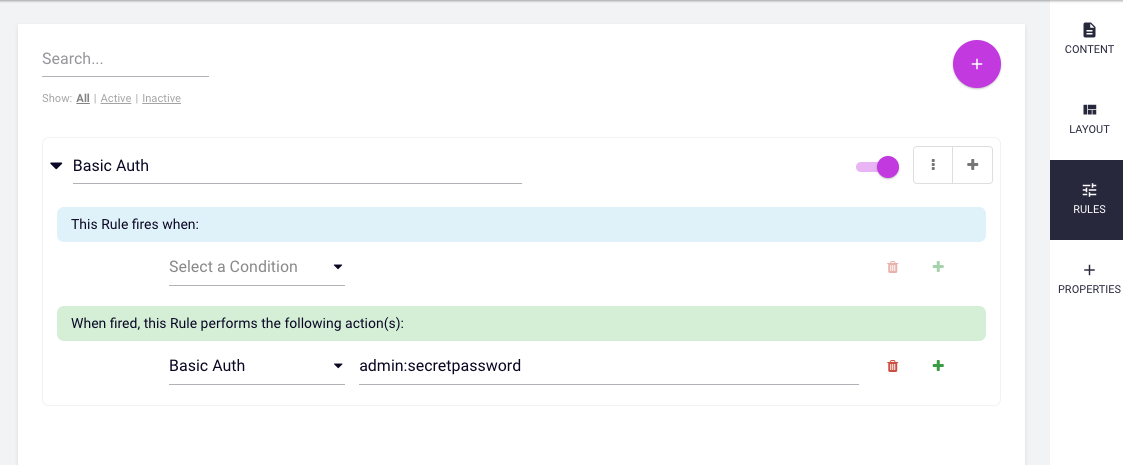
Earlier versions configured Basic Auth through a Rules Engine actionlet (Rule Engine portlet →
add a rule → "Basic Auth" action → username:password). This path is still supported for backward
compatibility — existing rules keep working — but it is not recommended for new setups because a
rule only fires during page rendering and therefore cannot gate asset sub-resources (CSS/JS/images):
the browser-replayed Authorization header on those requests reaches the asset servlets directly,
where the actionlet has no say. Use the interceptor for full page + sub-resource coverage.
Both ship in the plugin; exactly one enforces a given request:
AUTO(default): the interceptor gates the hosts inBASICAUTH_HOSTS; the actionlet enforces on any host the interceptor is not gating. Upgrading an existing install changes nothing until you setBASICAUTH_HOSTS— your rules keep enforcing. To migrate, setBASICAUTH_HOSTS/BASICAUTH_CREDENTIALSfor those hosts (the interceptor takes over and the rule auto-yields), then delete the rule.INTERCEPTOR: the interceptor enforces everywhere; the actionlet never challenges (existing rules become inert).ACTIONLET: the legacy rule enforces everywhere; the interceptor never runs even ifBASICAUTH_HOSTSis set.