
Compile and execute YAML semantic models as analytical SQL across multiple database dialects











OrionBelt Semantic Layer is an API-first semantic engine and query planner for AI agents that compiles and executes declarative YAML model definitions as optimized SQL for BigQuery, ClickHouse, Databricks, Dremio, DuckDB/MotherDuck, MySQL, Postgres, and Snowflake. Query using business concepts — dimensions, measures, and metrics — instead of raw SQL.
Analytics as Code — Define your analytical semantics in version-controlled YAML, compile to dialect-specific SQL, and execute against live databases, all through a single API. No BI tool in the middle: the full loop from declarative model to query results is programmable, reviewable, and reproducible.
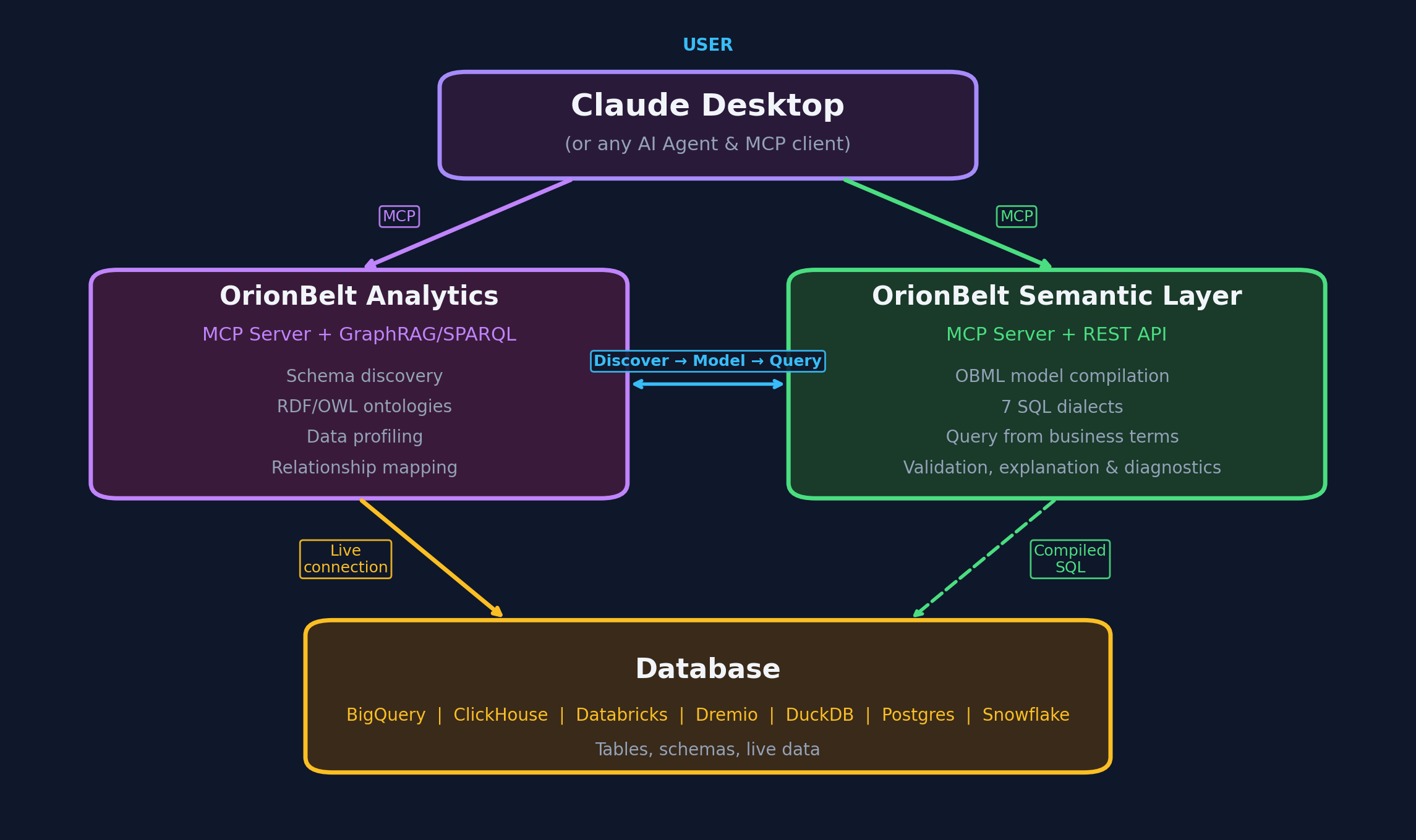
Companion Project: OrionBelt Analytics — an ontology-based MCP server that analyzes database schemas and generates RDF/OWL ontologies. Together they let AI assistants navigate your data landscape through ontologies and compile safe, dialect-aware analytical SQL.
- Try it in 30 Seconds — Live Demo | Colab | PyPI | Docker
- Claude Desktop / MCP
- Why OrionBelt?
- Features
- Example
- Gradio UI
- Documentation
- Status & Roadmap
- Companion Project
- Development
Open the Live Demo — Gradio UI with a pre-loaded example model. Paste a query, pick a dialect, see SQL instantly.
API explorer: Swagger UI | ReDoc

pip install orionbelt-semantic-layerThen paste into a Python REPL:
from orionbelt.parser import ReferenceResolver, TrackedLoader
from orionbelt.compiler.pipeline import CompilationPipeline
from orionbelt.models.query import QueryObject, QuerySelect

model_yaml = """
version: "1.0"
dataObjects:
  Orders:
    code: ORDERS
    columns:
      Price: { code: PRICE, abstractType: float }
      Country: { code: COUNTRY, abstractType: string }
dimensions:
  Country:
    dataObject: Orders
    column: Country
    resultType: string
measures:
  Total Revenue:
    resultType: float
    aggregation: sum
    expression: "{[Orders].[Price]}"
"""

loader = TrackedLoader()
raw, source_map = loader.load_string(model_yaml)
resolver = ReferenceResolver()
model, result = resolver.resolve(raw, source_map)

query = QueryObject(select=QuerySelect(dimensions=["Country"], measures=["Total Revenue"]))
pipeline = CompilationPipeline()
output = pipeline.compile(query, model, "postgres")
print(output.sql)
Output:
SELECT
  "Orders"."COUNTRY" AS "Country",
  CAST(SUM("Orders"."PRICE") AS NUMERIC(18, 2)) AS "Total Revenue"
FROM ORDERS AS "Orders"
GROUP BY "Orders"."COUNTRY"
No env file needed — the compilation pipeline is stateless.
Stage 1 — Zero-config start (models loaded later via API or UI):
docker run -p 8080:8080 ralforion/orionbelt-apiOpen http://localhost:8080/docs to explore the API.
Stage 2 — Realistic setup with docker compose:
# docker-compose.yml
services:
  api:
    image: ralforion/orionbelt-api:1.8.1
    ports: ["8080:8080"]
    env_file: .env
    volumes:
      - ./models:/app/models:ro
    environment:
      MODEL_FILE: /app/models/my-model.obml.yml

  ui:
    image: ralforion/orionbelt-ui:1.8.1
    ports: ["7860:7860"]
    environment:
      API_BASE_URL: http://api:8080
docker compose up -dSee .env.template for the full environment variable reference.
Docker notes:
API_SERVER_HOSTis already0.0.0.0inside the container — no override needed.- MCP via stdio does not work in Docker. Use the MCP HTTP client for containerized deployments.
- Mount models to
/app/models(or any path) and setMODEL_FILEto pre-load on startup.- For production, pin a version tag (
:1.8.1) rather than:latest.
The MCP server is a separate thin client that delegates to the REST API:
Add to your Claude Desktop claude_desktop_config.json:
{
  "mcpServers": {
    "orionbelt": {
      "command": "uvx",
      "args": ["orionbelt-semantic-layer-mcp"]
    }
  }
}
Also works with Copilot, Cursor, and Windsurf. See the MCP repo for full setup options.
| OrionBelt | dbt Semantic Layer | Cube | Malloy | |
|---|---|---|---|---|
| Model format | YAML-only (OBML) | Python + YAML | JavaScript | Custom DSL |
| SQL generation | AST-based (injection-safe) | String templates | String templates | Compiler |
| Multi-dialect | 8 dialects, no runtime lock-in | dbt Cloud required | Cube Cloud or self-host | BigQuery-focused |
| Multi-fact queries | Star Schema + CFL planner (fan-trap prevention) | Limited | Pre-aggregations | Automatic joins |
| Integration surface | REST API + MCP + Gradio UI | dbt Cloud API | REST + GraphQL | VS Code extension |
| Deployment | Self-host anywhere, single binary | SaaS (Cloud) | SaaS or self-host | Library |
| License | BSL 1.1 (converts to Apache 2.0) | Apache 2.0 | AGPL / proprietary | MIT |
- OBML Format — YAML-based semantic models with data objects, dimensions, measures, metrics, and joins
- Cross-Schema Queries — model data objects across multiple databases and schemas in a single model
- Static Model Filters — mandatory WHERE conditions baked into the model, auto-applied with join extension
- OBSL Graph & SPARQL — RDF graph export and read-only SPARQL querying for every loaded model
- OSI Interoperability — bidirectional conversion between OBML and Open Semantic Interchange format
- 8 SQL Dialects — BigQuery, ClickHouse, Databricks, Dremio, DuckDB/MotherDuck, MySQL, Postgres, Snowflake
- AST-Based Generation — custom SQL AST ensures correct, injection-safe SQL (not string templates)
- Star Schema & CFL — automatic join resolution with Composite Fact Layer for multi-fact queries
- Data Types & Precision — automatic CAST wrapping with dialect-specific type rendering and precision clamping
- Display Formatting — number format patterns (
#,##0.00,0.00%) on measures/metrics with locale-aware rendering - Timezone Settings — auto-detect database session timezone with
defaultTimezonefallback and ISO 8601 serialization - sqlglot Validation — post-generation syntax check across all supported dialects
- REST API — FastAPI endpoints for model management, validation, compilation, and execution
- MCP Server — separate thin client for Claude, Copilot, Cursor, Windsurf
- AI Integrations — LangChain, OpenAI Agents SDK, CrewAI, Google ADK, Vercel AI SDK, n8n, ChatGPT
- Gradio UI — interactive web interface for model editing, query testing, and ER diagrams
- DB-API 2.0 + Flight SQL — PEP 249 drivers and Arrow Flight SQL server for DBeaver, Tableau, Power BI
- Source-Position Errors — validation errors report exact YAML line and column
- ER Diagrams — interactive Mermaid diagrams with zoom and download (MD/PNG/Turtle)
- Session Management — TTL-scoped sessions with thread-safe model isolation
- JSON Schema — full OBML and query schema for IDE autocompletion (
yaml-language-server)
# yaml-language-server: $schema=https://raw.githubusercontent.com/ralfbecher/orionbelt-semantic-layer/main/schema/obml-schema.json
version: "1.0"
dataObjects:
  Customers:
    code: CUSTOMERS
    database: WAREHOUSE
    schema: PUBLIC
    columns:
      Customer ID: { code: CUSTOMER_ID, abstractType: string }
      Country:     { code: COUNTRY, abstractType: string }

  Orders:
    code: ORDERS
    database: WAREHOUSE
    schema: PUBLIC
    columns:
      Order Customer ID: { code: CUSTOMER_ID, abstractType: string }
      Price:             { code: PRICE, abstractType: float }
      Quantity:          { code: QUANTITY, abstractType: int }
    joins:
      - joinType: many-to-one
        joinTo: Customers
        columnsFrom: [Order Customer ID]
        columnsTo: [Customer ID]

dimensions:
  Country:
    dataObject: Customers
    column: Country
    resultType: string

measures:
  Revenue:
    resultType: float
    aggregation: sum
    expression: "{[Orders].[Price]} * {[Orders].[Quantity]}"
dataType: "decimal(18, 2)"# Create a session
curl -s -X POST http://localhost:8080/v1/sessions | jq .session_id
# -> "a1b2c3d4"
# Load the model
curl -s -X POST http://localhost:8080/v1/sessions/a1b2c3d4/models \
-H "Content-Type: application/json" \
-d '{"model_yaml": "..."}' | jq .model_id
# -> "abcd1234"
# Compile a query
curl -s -X POST http://localhost:8080/v1/sessions/a1b2c3d4/query/sql \
-H "Content-Type: application/json" \
-d '{"model_id":"abcd1234","query":{"select":{"dimensions":["Country"],"measures":["Revenue"]}},"dialect":"postgres"}' \
| jq -r .sqlGenerated SQL (Postgres)
SELECT
  "Customers"."COUNTRY" AS "Country",
  CAST(SUM("Orders"."PRICE" * "Orders"."QUANTITY") AS NUMERIC(18, 2)) AS "Revenue"
FROM WAREHOUSE.PUBLIC.ORDERS AS "Orders"
LEFT JOIN WAREHOUSE.PUBLIC.CUSTOMERS AS "Customers"
  ON "Orders"."CUSTOMER_ID" = "Customers"."CUSTOMER_ID"
GROUP BY "Customers"."COUNTRY"
Change dialect to bigquery, clickhouse, databricks, dremio, duckdb, mysql, or snowflake for dialect-specific SQL.
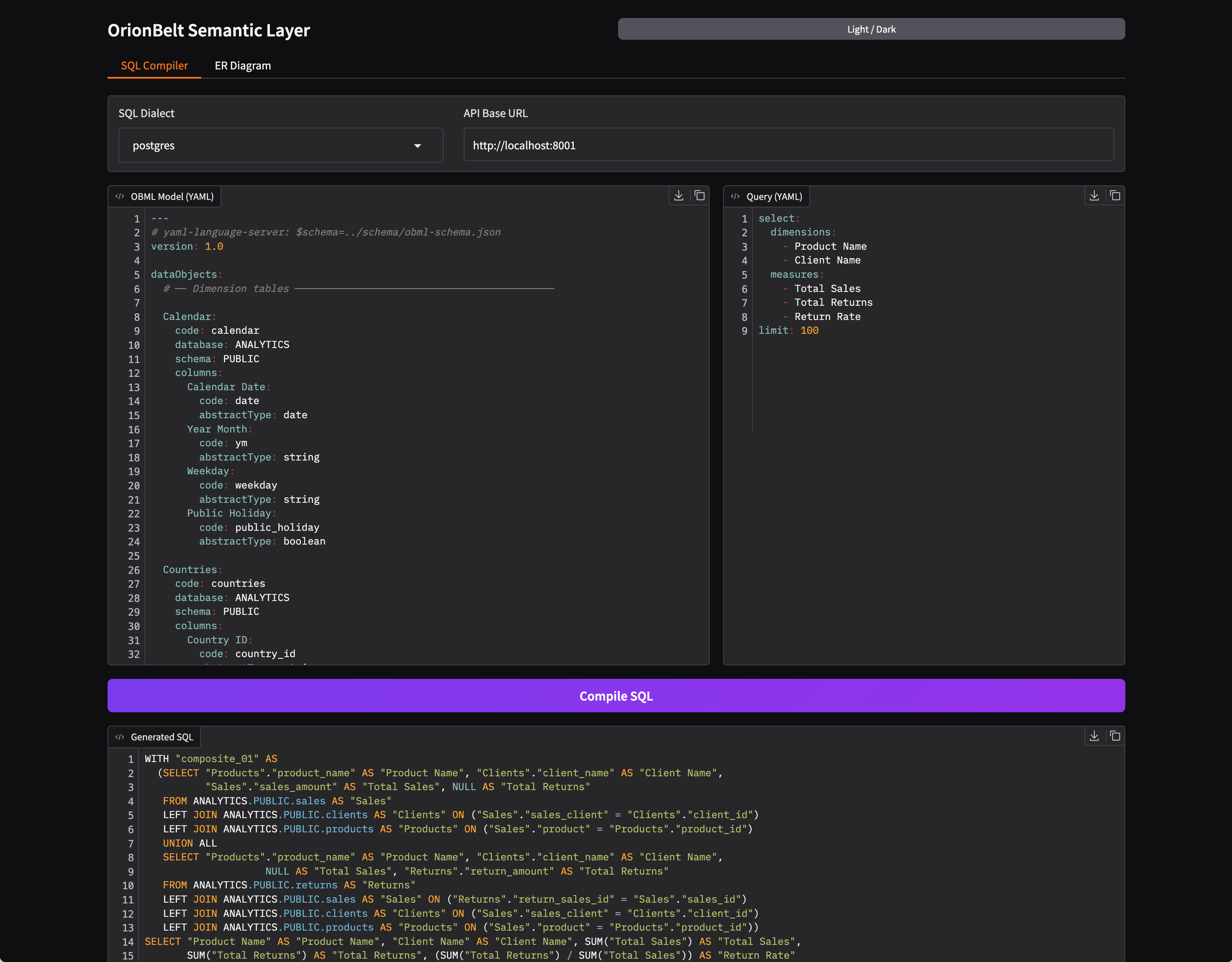
- SQL Compiler — side-by-side OBML model and query editors with syntax highlighting, 8 dialect selector, one-click compilation with formatted SQL output and query explain
- Query Execution — execute compiled queries against a connected database, view results with locale-aware number formatting, response metadata panel, TSV download and clipboard copy (requires
QUERY_EXECUTE=true) - ER Diagram — interactive Mermaid ER diagram with zoom, column toggle, and download (MD/PNG/Turtle)
- Editor Toolbar — clear, undo, redo, upload, download, and copy buttons on all code editors
- OSI Import/Export — convert between OBML and OSI formats
- Dark/Light Mode — toggle via header button, state persisted across sessions
Embedded mode — the UI is mounted at /ui on the API server:
pip install orionbelt-semantic-layer && orionbelt-api
# -> UI at http://localhost:8000/ui
Standalone mode — run API and UI as separate processes:
orionbelt-api                                              # API on :8000
orionbelt-ui                                               # UI on :7860 (connects to API on :8000)
API_BASE_URL=http://remote-api:8080 orionbelt-ui # point UI to a remote API| Topic | Link |
|---|---|
| Full docs site | ralforion.com/orionbelt-semantic-layer |
| Installation | getting-started/installation |
| Quick Start | getting-started/quickstart |
| Docker & Deployment | getting-started/docker |
| Development | getting-started/development |
| OBML Model Format | guide/model-format |
| Query Language | guide/query-language |
| SQL Dialects | guide/dialects |
| Period-over-Period Metrics | guide/period-over-period |
| Compilation Pipeline | guide/compilation |
| OBSL Graph & SPARQL | guide/obsl |
| Gradio UI | guide/ui |
| AI Integrations | guide/integrations |
| OSI Interoperability | guide/osi |
| REST API Endpoints | api/endpoints |
| DB-API Drivers & Flight SQL | drivers |
| Architecture | reference/architecture |
| Configuration | reference/configuration |
| Sales Model Walkthrough | examples/sales-model |
| Multi-Dialect Output | examples/multi-dialect |
| Multi-Fact: Sales & Returns | examples/multi-fact |
| TPC-DS Benchmark | examples/tpcds |
| Quickstart Notebook | examples/quickstart.ipynb |
| Status | Area |
|---|---|
| Shipped | 8 SQL dialects, REST API, MCP server, Gradio UI, DB-API drivers, Flight SQL, OBSL/SPARQL, OSI interop, AI integrations (LangChain, CrewAI, ADK, etc.), model inheritance & extends, data types & numerical precision, timezone settings, grain & filter context overrides |
| In progress | Additional dialects, CLI tool |
| Planned | Authentication & API tokens, CLI for automation & CI/CD, DDL view generation (CREATE VIEW from queries), additional BI tool integrations |
An ontology-based MCP server that analyzes relational database schemas and generates RDF/OWL ontologies. Together with OrionBelt Semantic Layer, it enables AI assistants to navigate your data landscape through ontologies and compile safe, dialect-aware analytical SQL.
Contributing to OrionBelt or running from source:
git clone https://github.com/ralfbecher/orionbelt-semantic-layer.git
cd orionbelt-semantic-layer
uv sync                           # install all deps (dev, docs, ui, flight, drivers)
uv run orionbelt-api              # start API on :8000
# Quality
uv run pytest # run tests
uv run ruff check src/ # lint
uv run ruff format src/ tests/ # format
uv run mypy src/ # type check
# Docs
uv sync --extra docs && uv run mkdocs serve # docs on :8080Copyright 2025 RALFORION d.o.o.
Licensed under the Business Source License 1.1. The Licensed Work will convert to Apache License 2.0 on 2030-03-16.
By contributing to this project, you agree to the Contributor License Agreement.
