



Trust middleware for LLM agents: deterministic tool policy, HITL approvals, and tamper-evident audit traces. Alpha - read the implementation status before customer-facing pilots.
The wedge is narrow by design: Pramagent does not prevent your model from being wrong; it prevents your model from doing damage when it is wrong.
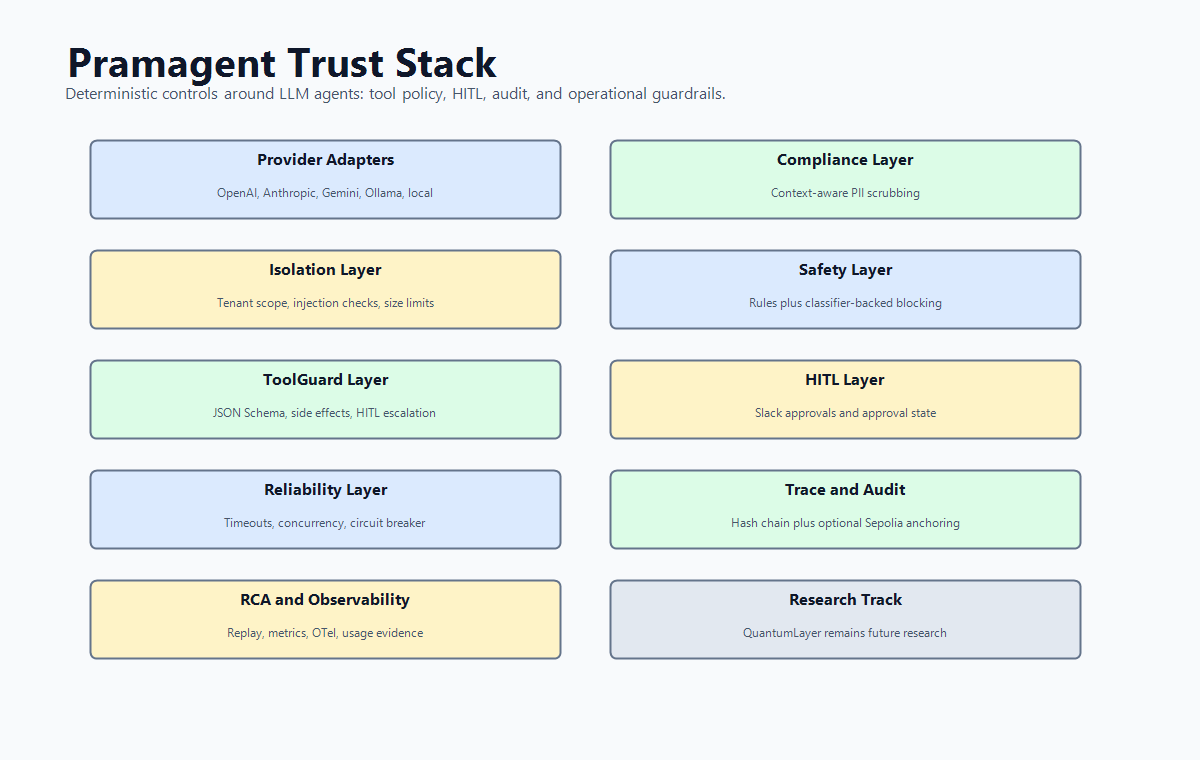
Pramagent wraps OpenAI, Anthropic, Gemini, Ollama, local, and OpenAI-compatible providers with guardrails that run outside the model. The most differentiated layer is ToolGuard: deterministic tool validation with JSON Schema, tenant/action allow-lists, side-effect taxonomy, dangerous-chain detection, output scanning, and HITL escalation. The current package also ships curated safety rule corpora, persistent HITL queues, thin adapters for popular agent frameworks, compliance evidence generation, and DeepMind/AWS-style conformance labels on every trace. It also includes an optional agent-memory integrity contract, structured decision-rationale schema, and a human-labeled overreach corpus for measuring valid-goal overreach.
Pramagent is an honest alpha. The core trust pipeline is real and tested; the gaps are around it. Use this to decide whether it fits your use case.
Ready for today:
- Developer evaluation and integration against the SDK and FastAPI sidecar
- Single-tenant or trusted-network pilots with a persistent store configured
(
PRAMAGENT_POSTGRES_DSNorPRAMAGENT_DB) — the API refuses to boot on volatile memory unless you explicitly opt in - Design-partner deployments where you control the network boundary
- Generating compliance evidence (control mappings, not certifications)
Not ready for yet — do not claim:
- Production banking / healthcare or other regulated environments
- Multi-tenant SaaS at scale (no published HA/soak evidence, no backup/DR runbook, no SLA)
- Prompt-injection immunity, certified GDPR/SOC 2/HIPAA compliance, or third-party-validated safety — none of these have been externally assessed
What backs this: 720 passing integration-first tests across Python 3.10–3.13, CI security scanning (Bandit, Semgrep, authenticated OWASP ZAP), and three prior engineering audits whose release-blocking findings are remediated and verified in the current source. Those audit reports are kept in the repo with remediation banners so you can read both the original findings and their fixes — see Full audit and Enterprise review.
Pramagent is published as Alpha software. It has live smoke-test evidence for Sepolia anchoring, S3 cold archive, local load testing, real OpenAI/Ollama provider calls, and bundled red-team runs, but it has not passed an external penetration test, SOC 2 audit, HIPAA assessment, or regulated-production certification.
Do not treat Pramagent as bank-grade or healthcare-grade security infrastructure. Do not claim prompt-injection immunity, production compliance, or third-party-validated safety from the bundled benchmarks alone. Read Implementation status, Live test results, and Hardening guide before using it in a customer-facing pilot. The June 11 active security prompt results are tracked in Security test results. The DeepMind/AWS agent-security mapping is tracked in Conformance map. Deferred controls and the reasoning behind them are tracked in Design decisions. The YC/product-readiness gap list and commercial hardening roadmap are tracked in Enterprise readiness roadmap.
Start here: Getting Started With Pramagent walks from install to provider setup, agent wrapping, ToolGuard, HITL, trace storage, dashboard/API, and real workflow demos.
Try the public demo: run the API and open /demo. The front-door scenario
is financial tool-calling safety: a payment-like action is held for HITL before
any provider call and sealed into a verifiable trace. No provider key is needed
for that zero-config path. Visitors can optionally enter an NVIDIA NIM
nvapi-* key, OpenAI sk-* key, or Gemini API Studio key for live model
answers; keys are used for that request only and never persisted.
One-command local demo:
pip install "pramagent[api]"
pramagent demo
# open http://127.0.0.1:8080/demoThis works with the base package only. No Docker, API server, or provider key is required.
pip install pramagentimport asyncio
from pramagent import Pramagent
async def main():
resp = await Pramagent().run("Summarize this request", tenant_id="demo", session_id="s1")
print(resp.output)
print(resp.trace.this_hash)
print(resp.trace.detection_tier, resp.trace.response_tier)
asyncio.run(main())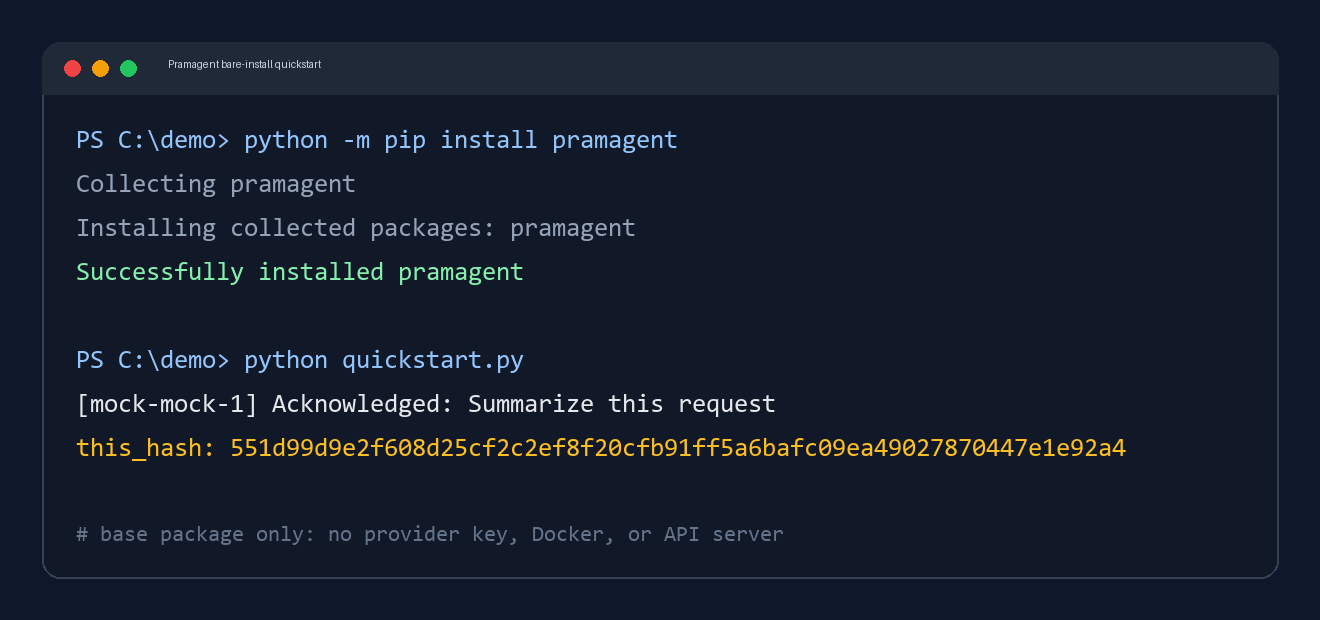
That creates a tamper-evident trace using the deterministic mock provider.
Swap to a real OpenAI model by setting OPENAI_API_KEY:
from pramagent import Pramagent
from pramagent.providers import OpenAIProvider

armor = Pramagent(provider=OpenAIProvider(model="gpt-4o-mini"))
Run against NVIDIA NIM with an nvapi-* key:
from pramagent import Pramagent
from pramagent.providers import NvidiaProvider

armor = Pramagent(provider=NvidiaProvider(model="meta/llama-3.3-70b-instruct"))How do I add safety guardrails to an LLM agent?
Install Pramagent and wrap your agent call with the trust stack. Pramagent
enforces deterministic policy outside the model, so the LLM cannot override the
tool policy, HITL gate, or audit chain by changing its own text output.
How do I audit AI agent decisions in production?
Every Pramagent call produces a hash-chained TraceEvent with layer decisions,
verdicts, provider metadata, PII redactions, HITL status, and this_hash /
prev_hash. New traces also include aws_scope, detection_tier,
response_tier, attack_techniques, and conformance_metrics so the same
evidence can be read through DeepMind/AWS agent-security vocabulary. The local
chain can be verified and optionally anchored externally.
How do I declare AWS agent autonomy scope?
Pass agent_scope="scope_1", "scope_2", or "scope_3" to Pramagent, or
set PRAMAGENT_AGENT_SCOPE for the API sidecar. Scope 1 blocks non-read side
effects. Scope 2 requires human approval for non-read tools even if a policy
was accidentally configured as ALLOW. Scope 3 records bounded-autonomy intent
and relies on your configured ToolGuard/HITL/rate-limit policies.
How do I prevent prompt injection in a Python LLM agent?
IsolationLayer scans inputs before the model sees them. It covers known
instruction overrides, chat-template wrapper attacks, authority framing,
base64/hex/unicode-escape encoded payloads, and targeted multilingual override
phrases. v0.8.0 adds structured classifier verdicts, held-out PINT/TensorTrust
style fixtures, provenance-aware stricter scanning for tool output and
retrieved content, and optional pramagent[ml] embedding/DeBERTa layers. This
is defense-in-depth, not proof of prompt-injection immunity.
How do I stop unsafe model output from reaching users?
OutputJudgeLayer runs an LLM-as-judge on every output before it returns — the
"is the OUTPUT safe?" check that regex cannot give. It catches semantic failures
deterministic rules miss (working malware, bypass walkthroughs, confirmed
destructive actions, leaked internals). On by default in the public demo, opt-in
for /v1/run (PRAMAGENT_OUTPUT_JUDGE=1). It is fail-closed, but it is itself a
model — strong defense-in-depth, not a guarantee.
How do I stop unsafe tool calls from an AI agent?
Use ToolGuardLayer with ToolPolicy. Pramagent validates JSON Schema,
tenant/action allow-lists, side-effect class, call frequency, argument
injection, and dangerous chains before any side effect can execute.
Can I trial policies without breaking production workflows?
Yes. Construct Pramagent(enforcement_mode="observe") or set
PRAMAGENT_ENFORCEMENT_MODE=observe for the API sidecar. Observe mode records
trace.would_block=True, trace.would_block_reason, and a *.observe
LayerEvent, but lets Safety/ToolGuard/Scope policy decisions continue so teams
can tune policies. Consent, size caps, and injection isolation still fail
closed.
Can security teams review policies without editing Python?
Yes. pramagent.policies.load_tool_guard("policies.json") loads ToolPolicy
definitions from JSON, and YAML is supported with pip install pyyaml or
pramagent[policy]. pramagent backtest policies.json --cases cases.jsonl
runs proposed policy changes against explicit tool-call cases and exits
nonzero on expected-verdict mismatches.
How do I add human approval to AI agent actions?
Use HITLLayer or a ToolGuard policy with Verdict.ESCALATE. Silence is never
consent: if approval does not arrive, the action remains unexecuted.
Does Pramagent work with OpenAI, Anthropic, Gemini, Ollama, and local models?
Yes. Pramagent ships provider adapters for OpenAI, Anthropic, Gemini, Ollama,
NVIDIA NIM, and OpenAI-compatible local endpoints, plus a deterministic mock
provider for tests.
Is Pramagent compliant with SOC 2, HIPAA, or the EU AI Act?
No. Pramagent includes compliance evidence mapping and tamper-evident logging
features that can support an assessment, but it has not passed SOC 2, HIPAA, EU
AI Act conformity assessment, or an external penetration test.
pip install "pramagent[api,dashboard,redis,postgres]"From source:
git clone git@github.com:sriram7737/pramagent.git
cd Pramagent
pip install -e ".[dev,api,redis,postgres,dashboard]"pramagent init
pramagent validateRun the local stack:
cp .env.example .env
docker compose up -d
Open:
- API docs:
http://localhost:8080/docs - Dashboard:
http://localhost:8501
The API serves a single-page product demo at /demo. It is enabled by default
so a new evaluator reaches the trust-stack proof immediately; set
PRAMAGENT_DEMO_ENABLED=false for API-only deployments.
pip install "pramagent[api]"
pramagent demo
pramagent demo sets demo-safe local defaults in that process:
PRAMAGENT_DEMO_ENABLED=true, PRAMAGENT_ALLOW_MEMORY_STORE=1, and
PRAMAGENT_PROVIDER=mock.
The first scenario needs no provider key: it routes a financial transfer
request through deterministic policy, pauses it at HITL, and returns the trace
plus this_hash / prev_hash. This is the five-minute wedge: financial
side-effect safety before the model is trusted.
Visitors can optionally bring a provider key on each run: nvapi-* for NVIDIA
NIM models, sk-* / sk-proj-* for OpenAI gpt-4o-mini, or an AI Studio
Gemini key for gemini-2.5-flash. Pramagent uses that key only for the current
provider call; it is not written to traces, logs, stores, usage records, or the
hash-chain payload. Each demo run uses an isolated in-memory trace store and
returns the output, trust-layer events, redactions, HITL state, latency,
DeepMind/AWS-style conformance fields, this_hash, prev_hash, and local
chain verification.
The demo also includes optional product signals. If a visitor checks the anonymous usage box, Pramagent records only a process-salted hashed visitor ID, provider kind, verdict, HITL state, and conformance tiers. It never records prompts, outputs, provider keys, IP addresses, or plaintext email. The managed-pilot form stores salted contact hashes plus a short use-case label with obvious email/phone values redacted, so demand can show up as data without turning the demo into a tracking surface.
Set PRAMAGENT_DEMO_ADMIN_KEY to enable the protected operator view at
/demo/admin/signals. The browser page asks for that key and then calls
/demo/admin/signals.json with an Authorization: Bearer ... header; the key
is never placed in a URL. By default these signals are process-local memory.
Set PRAMAGENT_DEMO_SIGNALS_POSTGRES_DSN to persist them to Postgres, and set
PRAMAGENT_DEMO_SIGNAL_SALT when you want hashed visitor/contact identifiers
to remain stable across restarts. The persisted schema still stores only
hashed/scrubbed fields, not prompts, outputs, provider keys, IPs, or plaintext
contacts.
The public throttle is keyed by client IP plus a short in-memory SHA-256 hash
of the visitor's provider key. The no-key deterministic path is throttled by
IP. If a visitor switches to a different key, they get a fresh demo bucket
without Pramagent storing the plaintext key.
A DEGRADED demo result means the upstream model call failed and Pramagent
returned its safe default with a trace. NVIDIA HTTP 403 usually means the
NVIDIA organization lacks hosted Public API Endpoints access; changing models
usually will not fix that entitlement issue.
Dashboard evidence from the authenticated June 21 smoke run is captured in
Demo evidence.
It includes screenshots for safe output, PII scrubbing, prompt-injection
blocking, destructive database-operation blocking, HITL-held financial action,
trace hashes, and the dashboard metric fix that reports engine latency
separately from human approval wait time. The evidence set also includes the
current console redesign preview: single-brand navigation, dense trace detail
with raw/scrubbed payloads, terminal EXPIRED approval states, and a
favicon-size proof for the Pramagent mark. The packaged dashboard serves the
new Pramagent SVG mark from /static across authenticated and pre-auth key
flows.
Run the release sanity checks:
python -m pytest -q --tb=no
python -m pramagent.cli redteam --json --attacks 100
python -m pramagent.cli redteam --json --dynamic --attacks 200 --seed 999
Current local result: 684 passed, 2 skipped. The latest targeted prompt
suite also passed with 0 failures across emergency override, output override,
margin/liquidation, IBAN/SWIFT, ambiguous escalation, PHI, false-positive,
base64, hex, unicode-escape, multilingual override-token, and
chat-template-wrapper cases.
import asyncio

from pramagent import Pramagent, Verdict
from pramagent.layers import ToolGuardLayer, ToolPolicy
from pramagent.layers.tool_guard import SideEffect

guard = ToolGuardLayer(policies=[
    ToolPolicy(
        name="send_payment",
        side_effect=SideEffect.PAYMENT,
        action=Verdict.ESCALATE,
        allowed_tenants={"finance_team"},
        schema={
            "type": "object",
            "required": ["amount_usd", "destination"],
            "properties": {
                "amount_usd": {"type": "number", "minimum": 0.01, "maximum": 5000},
                "destination": {"type": "string", "pattern": r"acct-\d{6,}"},
            },
            "additionalProperties": False,
        },
    )
])

armor = Pramagent(tool_guard=guard)

async def main():
    decision = armor.validate_tool(
        "send_payment",
        {"amount_usd": 250.00, "destination": "acct-123456"},
        tenant_id="finance_team",
        session_id="demo",
    )
    print(decision.verdict)  # ESCALATE

    too_large = armor.validate_tool(
        "send_payment",
        {"amount_usd": 9000.00, "destination": "acct-123456"},
        tenant_id="finance_team",
        session_id="demo",
    )
    print(too_large.verdict, too_large.reason)  # BLOCK: schema violation

    wrong_tenant = armor.validate_tool(
        "send_payment",
        {"amount_usd": 250.00, "destination": "acct-123456"},
        tenant_id="marketing_team",
        session_id="demo",
    )
    print(wrong_tenant.verdict, wrong_tenant.reason)  # BLOCK: tenant mismatch

    response = await armor.run(
        "Summarize this payment request",
        tenant_id="finance_team",
        session_id="demo",
        action="send_payment",
    )
    print(response.hitl)
    print(response.trace.this_hash)

asyncio.run(main())Security teams can review ToolGuard definitions as JSON/YAML files instead of hardcoding them in application code.
policies.json:
{
  "policies": [
    {
      "name": "send_payment",
      "side_effect": "payment",
      "action": "escalate",
      "allowed_tenants": ["finance_team"],
      "schema": {
        "type": "object",
        "required": ["amount_usd", "destination"],
        "properties": {
          "amount_usd": {"type": "number", "minimum": 0.01, "maximum": 5000},
          "destination": {"type": "string", "pattern": "acct-\\d{6,}"}
        },
        "additionalProperties": false
      }
    }
  ]
}
from pramagent import Pramagent
from pramagent.policies import load_tool_guard
armor = Pramagent(tool_guard=load_tool_guard("policies.json"))Backtest before merging a policy PR:
pramagent backtest policies.json --cases cases.jsonlcases.jsonl uses one JSON object per historical/proposed tool call:
{"case_id":"pay-001","tool_name":"send_payment","arguments":{"amount_usd":250,"destination":"acct-123456"},"tenant_id":"finance_team","expected":"escalate"}This v0 backtest contract is explicit case replay. Stored-trace replay over the last 30 days is on the roadmap once deployments have a stable tool-call export shape.
For custom Python agents, wrap existing tools without rewriting the execution loop:
from pramagent.adapters import guarded_tool

@guarded_tool(armor, policy="send_payment")
def send_payment(amount_usd: float, destination: str):
    ...
BLOCK and ESCALATE both stop the function before the side effect runs.
Use the persistent HITL queue/dashboard path to approve and then re-run the
side effect intentionally; the decorator never treats escalation as consent.
Pramagent now includes deterministic, importable rule bundles. They are plain
Python Rule objects, so a reviewer can inspect exactly what is enforced.
from pramagent import Pramagent
from pramagent.layers import SafetyLayer
from pramagent.rules import ALL_RULES, JAILBREAK_PATTERNS, OWASP_LLM_TOP10

armor = Pramagent(
    safety=SafetyLayer(rules=[*JAILBREAK_PATTERNS, *OWASP_LLM_TOP10])
)

strict_armor = Pramagent(safety=SafetyLayer(rules=ALL_RULES))
Included corpora:
JAILBREAK_PATTERNSOWASP_LLM_TOP10INJECTION_CORPUSFICTIONAL_WRAPPERPHI_PATTERNSFINANCIAL_PII
Verdict.ESCALATE means "suspicious, but not certain enough to block." What
the pipeline does with it is configurable per stage — pre (the input pass,
before the model runs) and post (the output pass, after) — with one of
"log" (record and continue), "hitl" (route to the human-in-the-loop gate,
idle-on-silence), or "block" (hard stop). The default is "log" so adding an
ESCALATE rule never silently starts gating traffic; the ESCALATE verdict is
always recorded in the trace either way.
# Healthcare / finance — maximum caution
Pramagent(safety=SafetyLayer(rules=[...]),
          escalate_policy={"pre": "hitl", "post": "block"})

# Developer tool — minimal interruption (default)
Pramagent(safety=SafetyLayer(rules=[...]),
          escalate_policy="log")

# Internal enterprise — gate suspicious input, log suspicious output
Pramagent(safety=SafetyLayer(rules=[...]),
          escalate_policy={"pre": "hitl", "post": "log"})
A string applies to both stages; a dict sets them independently. Invalid values raise at construction, not at request time.
For approval flows that must survive process restarts, use the persistent queue backends:
from pramagent.layers import HITLLayer
from pramagent.queue import SQLiteHITLQueue

hitl = HITLLayer(
    require_approval_for=["send_email", "wire_transfer"],
    store=SQLiteHITLQueue("hitl.db"),
    timeout_s=None,  # wait until another process approves or denies
)InMemoryHITLQueue, SQLiteHITLQueue, and PostgresHITLQueue are available
under pramagent.queue.
Pramagent is meant to sit under existing agent frameworks, not replace them.
from pramagent.adapters import PramagentNode, PramagentHook, PramagentGuard

# LangGraph
guard_node = PramagentNode(armor=armor)

# AutoGen
PramagentHook(armor=armor).attach(agent)

# CrewAI
safe_tool = PramagentGuard(armor=armor).wrap_tool(send_email)
Generic helpers are also available:
from pramagent.adapters import protect, protect_toolComplianceReporter.generate() can produce point-in-time evidence packages
from Pramagent traces and mappings:
from pramagent.compliance import ComplianceReporter

ComplianceReporter(store=store, audit=audit).generate(
    framework="SOC2",
    period_start="2026-01-01",
    period_end="2026-06-30",
    tenant_id="demo",
    output="evidence.json",
)
Supported mapping targets include SOC2, HIPAA, GDPR, NIST AI RMF, EU AI Act, and PCI DSS. This is engineering evidence, not a certification.
- You are wrapping LLM calls or agent workflows and need audit trails, policy checks, HITL approvals, PII scrubbing, and provider fallback in one place.
- You want deterministic tool policy outside the model, especially for actions like payments, data export, account changes, or admin operations.
- You are building an internal tool or pilot where honest safety evidence matters more than marketing claims.
- You need tamper-evident traces with optional Sepolia anchoring and encrypted S3 cold archive support.
- You already use LangGraph, AutoGen, CrewAI, or a custom loop and want a thin trust layer around prompts, tool calls, and approvals.
- You need certified bank-grade, healthcare-grade, or SOC2-audited production infrastructure today.
- You need proven jailbreak resistance against a serious red team; the bundled benchmark is only a deterministic smoke test, not third-party assurance.
- You need mature enterprise dashboard auth such as SSO/OIDC/RBAC. Optional generated dashboard keys and SQL users exist, but this is not an enterprise IAM plane yet.
- You need production-grade scale evidence, chaos engineering, or SLA-backed capacity numbers beyond the published local Docker Compose load run.
- You need billing-grade Stripe/Chargebee metering rather than the local usage ledger and event hooks.
| Capability | Status | Notes |
|---|---|---|
| Provider adapters | Implemented | Mock, OpenAI, Anthropic, Gemini, Ollama, OpenAI-compatible/local |
| Rule corpora | MVP | 129 deterministic rules across jailbreaks, OWASP LLM risks, injection, fictional-wrapper bypasses, PHI, and financial PII |
| ToolGuard | Strong MVP | Draft 2020-12 JSON Schema, allow-lists, side-effect taxonomy, output scanning, Redis-backed chain state |
| HITL | Beta | Slack callbacks, persistent SQLite/Postgres queues, quorum/escalation primitives, ServiceNow/PagerDuty/email/webhook notifiers |
| Audit trail | Strong MVP | SHA-256 hash chain; optional real Sepolia anchoring |
| PII redaction | Strong MVP | Context-aware patterns for common regulated data; bounded email scrubbing avoids long-input regex DoS |
| Auth/rate limits/quotas | Beta | JWT/API keys, token buckets, per-tenant quotas |
| Framework adapters | MVP | LangGraph node, AutoGen hook, CrewAI guard, generic protect/protect_tool helpers |
| Dashboard | Prototype | Shared-key fallback, optional SQL users with generated keys, tenant scoping, traces, approvals, metrics, usage page, CSRF |
| Redis/Postgres backends | Beta | Wired and tested locally; needs scale/load testing |
| OpenTelemetry | Partial | Per-layer spans exist; dashboards and alerting need hardening |
| Red-team benchmark | MVP | Static and dynamic mutation modes; includes base64, translation-wrapper, and authority-framing regressions |
| Billing hooks | MVP | In-memory hash-chain usage ledger plus fail-open webhook; no Stripe/Chargebee provider yet |
| S3 cold archive | MVP | Gzip + encrypted trace archive wrapper; metadata sink hook |
| Compliance evidence | MVP | ComplianceReporter.generate() for JSON/text/PDF-style evidence packages |
Pramagent should not replace human workflows that already work. Treat it as a policy and evidence layer around risky agent actions, not as a mandate to put AI into every decision path.
Before integrating a new feature or agent workflow, require three gates:
- Isolation contract: declare which trust layers the feature touches. HITL features need a negative test proving the action cannot proceed without an authenticated approval. Isolation features need tenant/session boundary tests.
- Regression baseline: run the full suite plus the new feature tests. Zero regressions are allowed for previously passing safety, trace, auth, and store behavior.
- Consequence traceability: every approved or triggered action must leave a trace that explains why it was allowed, who/what approved it, what policy applied, and which downstream side effect was attempted.
The reusable reviewer prompt for this is in Security audit prompt.
- Prompt-injection defense is not complete. The bundled static corpus and
seeded dynamic mutation smoke tests now include base64, translation-wrapper,
and authority-framing regressions. v0.8.0 adds structured verdicts,
provenance-aware stricter scanning, held-out PINT/TensorTrust-style fixtures,
and optional
pramagent[ml]embedding/DeBERTa layers, but the project still needs larger third-party red-team sets and external assessment. - ToolGuard is a hard policy gate outside the model, but it is not a sandbox.
- ToolGuard chain detection and per-session call limits are per-process unless
a shared Redis backend is configured (
PRAMAGENT_TOOL_GUARD_REDIS_URLorPRAMAGENT_REDIS_URL). When running multiple uvicorn workers, a dangerous tool chain whose steps land on different workers is only detected with a shared Redis backend; the Redis path uses an atomic Lua append so concurrent same-session calls never lose history. - Slack is the main decision-collecting HITL adapter today. ServiceNow, PagerDuty, email, and generic webhooks are useful notification/escalation adapters. Persistent SQLite/Postgres approval queues exist, but broader enterprise approval workflows are still in development.
- Dashboard auth has tenant-scoped shared-key fallback plus optional SQL-backed users with generated dashboard keys and key regeneration. It is still not SSO/OIDC/RBAC-grade.
- Ethereum anchoring is Sepolia/testnet-oriented; no mainnet runbook, verifier contract, HSM/KMS key-management story, or enterprise anchoring operating model is included yet.
- The usage ledger is local audit evidence for pilots, not an invoice-grade billing system.
- Redis/Postgres support exists, but the stack has not been chaos-tested or load-tested for high-stakes deployments.
- No external penetration test or formal compliance certification has been run.
- QuantumLayer is future research only. It is not implemented, advertised as a feature, or exposed as a production API.
pip install "pramagent[ethereum,s3]"Ethereum/Sepolia anchoring submits the audit head as transaction calldata and stores the tx hash plus block number on the trace when configured. S3 cold archive wraps a primary store and archives pruned/erased traces as encrypted gzip JSON while keeping metadata available for compliance reporting.
pramagent init
docker compose up -d
python -m pytest -q --tb=no
python -m pramagent.cli redteam --json --dynamic --attacks 200 --seed 999
Then use the dashboard to inspect traces, pending HITL approvals, audit status, metrics, and per-tenant usage.
- Getting started
- Implementation status
- Conformance map
- Design decisions
- Overreach corpus
- Live test results
- Hardening guide
- Google Dev Library submission draft
- Cookbook submission plan
- Security test results
- More documentation
Apache-2.0.