

Electrical & Electronics Engineer (2026). I build autonomous systems where perception, estimation and control meet real hardware. My strongest work is wiring the full chain together and making it run in the field — not any single algorithm.
IAC 2026 author. Accepted, peer-reviewed paper on Edge-AI characterization and predictive targeting of tumbling space debris, validated hardware-in-the-loop (IAC-26,A6,IP,7 · x108379). Supporting code will be released after the conference.
Autonomous tracking turret (TEKNOFEST Çelikkubbe). Designed the end-to-end ROS 2 architecture as team captain: stereo vision, YOLO, adaptive Kalman estimation and a PLC/servo bridge with safety interlocks; field-tested across 70+ recorded runs.
Autonomous driving. Turkish National Technology Academy programme (foundation completed, specialization ongoing).
ROS 2 · Computer Vision (YOLOv8/v11, StereoSGBM) · EKF / UKF / Kalman estimation ·
Reinforcement Learning (PPO, MuJoCo) · C++ / Python (pybind11) · real-time systems ·
hardware integration (PLC/Modbus, serial, Jetson)
Autonomous counter-UAS turret in ROS 2: detection, tracking, 6-D Kalman estimation, lead-angle intercept solving and stabilized gimbal control, with an engagement state machine and safety interlocks. Nine nodes, a pure-Python core split from the ROS wrappers, 29 tests in CI, and a closed-loop demo that acquires and locks within two frames.

A 20-DOF mini humanoid that learns to walk from scratch with PPO in MuJoCo, reached through
10+ reward-shaping iterations. The trained policy is exported to pure NumPy so it runs inside
ROS 2 without PyTorch — bit-exact against Stable-Baselines3, and enforced in CI — and bridged
to Gazebo through URDF and ros2_control.
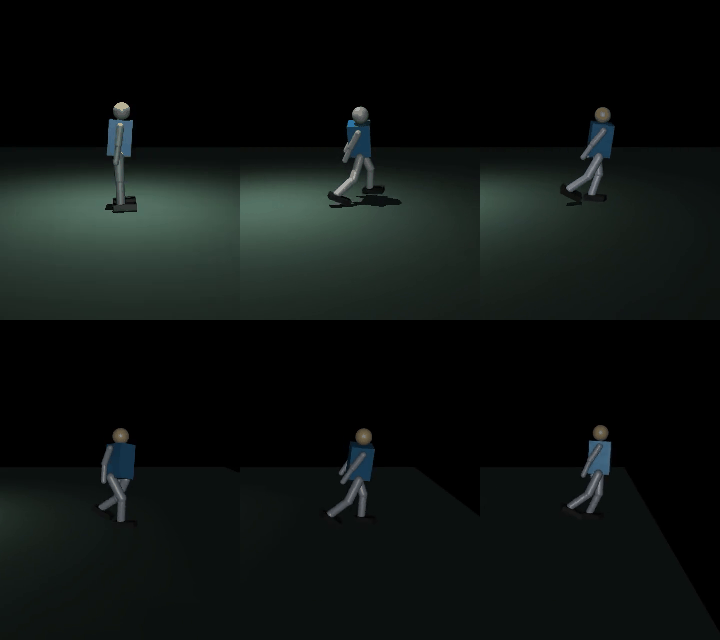
The gait is not scripted: it is a neural-network policy that discovered walking over roughly 8M simulation steps. Final policy: no falls in 600 steps, ~0.34 m/s, no both-feet-airborne phase.
End-to-end CubeSat autonomous flight-software simulator: multi-rate scheduler, EPS, attitude GNC, FDIR (fault detection, watchdog, analytical virtual-sensor fallback), comms, and an on-board edge-AI payload. Built for the Turkish Space Agency Astro Hackathon (4th place).
Profiling-driven C++/pybind11 acceleration of a real-time perception loop (RANSAC + Kalman), with a pure-Python reference proving numerical equivalence. Measured 10.7x on RANSAC and 3.0x on the Kalman kernels; both paths are verified in CI.
Zero-dependency conference-programme change tracker and author-catalog query tool, written to follow the IAC 2026 A6 (Space Debris) symposium.
Istanbul, Türkiye · LinkedIn